
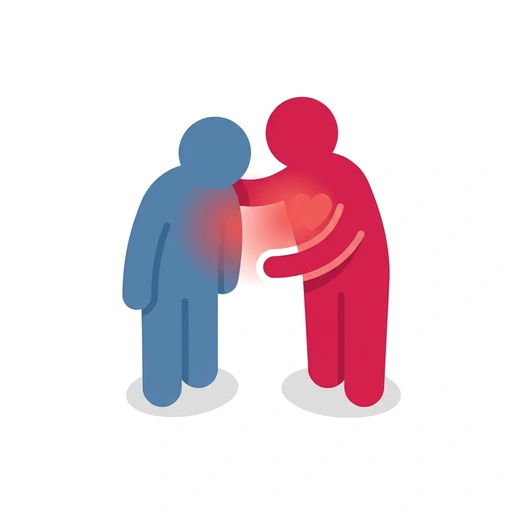
Affective Empathy: Feeling What Others Feel
Discover how your nervous system automatically mirrors the feelings of those around you. Learn to distinguish gut-level emotional resonance from intellectual perspective-taking, manage personal distress, and turn shared feelings into sustainable compassion.
Like Duolingo, but for Affective Empathy: Feeling What Others Feel. Tomo turns the whole topic into a game you play five minutes a day, until it actually sticks.
23 levels across 3 sections, about 46 minutes end to end, roughly 9 days at five minutes a day. It moves through Tuning In to Shared Emotion, Directing Resonance and Guarding Boundaries, and The Biological Engine and Variations. It starts from scratch.
Free forever · No credit card · iPhone & Android

Key ideas in Affective Empathy: Feeling What Others Feel
- Emotional contagion happens automatically through nonverbal cues like posture, vocal tone, and facial expressions
- Our bodies naturally 'catch' and mimic the physical states of people around us without conscious effort
- This shared physical state creates a matching visceral feeling in ourselves
- Affective empathy requires an intuitive boundary between your own feelings and the other person's
- Without a self-other distinction, catching distress turns into personal panic rather than helpful empathy
- Empathy means feeling with someone while still recognizing that the distress originates in them
- Mirroring someone's subtle physical cues gives you real-time feedback on their emotional state before they put it into words
- People often verbally downplay their distress while their body language signals they need support
- Affective empathy lets you tune in to unspoken tension and respond with appropriate compassion
- Visceral emotional resonance happens within fractions of a second (milliseconds)
- Affective mirroring operates on rapid, automatic subcortical pathways before slower conscious reasoning kicks in
- You often feel the echo of a smile or a frown before you consciously register what caused it
- Absorbed emotional states manifest as direct visceral sensations like stomach clenching, muscle tightening, or altered breathing
- Checking in with your physical body helps you track when an emotional state was picked up from an interaction rather than your own day
- Somatic awareness is the first clue for identifying emotional contagion in daily life
- Affective empathy is a gut-level, emotional reaction where you share someone's feelings in your own body
You've tried the other tabs
Thirty open tabs. Four facts you actually kept.
You watched. You nodded. By Sunday it was gone.
One answer, then back to scrolling.
Eight weeks. You meant to finish. You didn't.
Tomo gives Affective Empathy: Feeling What Others Feel the Duolingo treatment: levels, streaks, and quick quizzes that test what you just learned. That game loop is what the tabs above never had, so it's the one you actually finish.
Here's what playing it feels like
A real question from this course. Take your best guess.
Imagine sitting across from a close friend who is tense and frowning. What does your body naturally tend to do?
Get it right to open this lesson and 22 more in the app.
Where Affective Empathy: Feeling What Others Feel takes you
- 1
Tuning In to Shared Emotion
- Catching Shared Emotion in Daily Life
- Distinguishing Affective from Cognitive Empathy
- 2
Directing Resonance and Guarding Boundaries
- Separating Empathic Concern from Personal Distress
- Translating Emotional Resonance into Prosocial Action
- Guarding Against Empathy Fatigue and Burnout
- 3
The Biological Engine and Variations
- The Neuroscience of Feeling Others' Pain
- Developmental Origins and Clinical Variations
3 sections · 7 units · 23 levels. Built to play, not to enroll.
Tomo is in ChatGPT
Tomo is also a ChatGPT plugin: the same playable courses, built and played inside your chat.
Add Tomo to ChatGPT- What to ask
- “Make me a Tomo course on black holes.” “Turn this chat into a Tomo course.”
- What you get
- Quick questions with instant feedback, hearts and stars, ready to play in about a minute.
- Where it goes
- No sign-up to start. Connect your Tomo account and your streak carries on in the app.
You pick the voice
Affective Empathy: Feeling What Others Feel is taught in the Storyteller style: every lesson is a story. Want a different feel? In the app you can spin up the same topic in any of Tomo's teaching styles. Same facts, totally different vibe.
More Psychology on Tomo

Affective Empathy: How We Share Emotions
Discover why you absorb other people's emotional states, how to tell your feelings apart from theirs, and how to turn gut reactions into helpful support without burning out. This course offers practical psychological tools to navigate emotional contagion, regulate overwhelm, and understand the biological wiring behind shared feelings.

The Psychology of Empathy
Move beyond basic active listening to understand the distinct neural and cognitive mechanics of empathy. Learn to read others accurately without absorbing their distress or projecting your own assumptions.

Protecting Your Mind at Work
Learn practical, low-friction strategies to stop burnout before it starts, set clean boundaries without workplace guilt, and handle real-world office pressure with steady composure.

Psychological Science in Practice
Bridge foundational psychological theory and clinical practice for behaviour support and mental health care. Master executive cognitive processes, affective neuroscience, attachment systems, and functional formulation to navigate complex human behaviour with precision.

Clinical Psychology in Practice
Bridge the gap between textbook diagnoses and real clinical reasoning. Learn how practitioners formulate complex cases, differentiate tricky symptom profiles, and apply evidence-based interventions.

Reading People Like a Mentalist
Learn the psychological art of reading human behavior in real time. Decode nonverbal cues, spot baseline emotional shifts, and draw reliable deductions from everyday interactions.
Start Affective Empathy: Feeling What Others Feel today.
Download Tomo, search Affective Empathy: Feeling What Others Feel, and play your first lesson in under a minute.