
Applied Human Anatomy
Decode the architectural logic of the human body through topographical relationships, fascial planes, and systemic structural design. Move beyond simple memorization to understand how form governs function across every major system.
Like Duolingo, but for Applied Human Anatomy. Tomo turns the whole topic into a game you play five minutes a day, until it actually sticks.
22 levels across 3 sections, about 44 minutes end to end, roughly 9 days at five minutes a day. It moves through Spatial Logic and Structural Frameworks, Somatic Control and Movement Systems, and Visceral Topography and Fluid Circuits.
Free forever · No credit card · iPhone & Android
Key ideas in Applied Human Anatomy
- The cephalic flexure creates an approximate 80-to-90 degree bend between the brainstem/spinal cord long axis and the forebrain long axis
- Rostral means toward the frontal pole in the forebrain (anterior in thoracic terms), but toward the midbrain/cerebrum in the spinal cord (superior in thoracic terms)
- Dorsal transitions from posterior along the cord/brainstem to superior along the cerebral cortex
- Upper limb buds rotate 90 degrees laterally, positioning originally ventral flexor compartments on the adult anterior surface
- Lower limb buds rotate 90 degrees medially, positioning originally ventral flexor compartments on the adult posterior surface
- Limb rotations displace original dermatomal strips into a spiral arrangement along the lower limb compared to a parallel segmental arrangement in the upper limb
- Corticospinal motor tracts decussate in the medulla, traveling ipsilaterally down the cord to cause ipsilateral flaccid/spastic paralysis below the lesion
- Spinothalamic fibers cross near the level of entry within 1-2 segments, projecting contralaterally to cause contralateral analgesia
- Relational terms convey dynamic course relative to an axis of symmetry rather than fixed static coordinates
- The cardiac anatomical base-to-apex axis points obliquely anterior, inferior, and leftward, diverging from the vertical body axis
- The true cardiac short-axis plane is perpendicular to the interventricular septum and long axis, requiring double-oblique planes rather than standard thoracic transverse/axial CT slices
- A cardiac four-chamber view corresponds to an oblique coronal cut aligned along the base-to-apex plane, not a thoracic axial plane
- The dorsal columns exhibit strict onion-skin lamination: incoming fibers from lower segments are pushed medially as higher segments enter lateral to them
- The gracile fasciculus carries sacral and lumbar fibers medially; the cuneate fasciculus carries thoracic and cervical fibers laterally
- Somatotopic arrangements preserve spatial skin topography within deep, compressed white matter tracts
- Inelastic deep investing fascia restricts radial muscle expansion, converting muscle contraction into elevated intramuscular compartmental pressure
You've tried the other tabs
Thirty open tabs. Four facts you actually kept.
You watched. You nodded. By Sunday it was gone.
One answer, then back to scrolling.
Eight weeks. You meant to finish. You didn't.
Tomo gives Applied Human Anatomy the Duolingo treatment: levels, streaks, and quick quizzes that test what you just learned. That game loop is what the tabs above never had, so it's the one you actually finish.
Here's what playing it feels like
A real question from this course. Take your best guess.
You trace a tract 'rostrally' along the spinal cord, and then 'rostrally' through the cerebral cortex. In standard body coordinates, how does your direction change?
Get it right to open this lesson and 21 more in the app.
How to learn Applied Human Anatomy, step by step
Go in order. 22 short levels across 3 sections, about 44 minutes in all, five minutes a day.
- 1
Spatial Logic and Structural Frameworks
- Anatomical Orientation and Positional Logic
- Fascial Compartments and Tissue Planes
- 2
Somatic Control and Movement Systems
- Musculoskeletal Kinetics and Architecture
- Neuroarchitecture and Segmental Pathways
- 3
Visceral Topography and Fluid Circuits
- Cardiopulmonary Conduits and Thoracic Geometry
- Gastrointestinal and Hepatobiliary Topography
- Abdominopelvic and Excretory Architecture
3 sections · 7 units · 22 levels. Built to play, not to enroll.
Questions about Applied Human Anatomy
How do I learn Applied Human Anatomy?
Go in order: start with Spatial Logic and Structural Frameworks, then Somatic Control and Movement Systems, then Visceral Topography and Fluid Circuits. On Tomo that's 22 short levels, about 44 minutes in all, played five minutes a day. Start free and play the first level in under a minute.
Is there a Duolingo-style app for Applied Human Anatomy?
Yes. Tomo works like Duolingo: short daily lessons, streaks and quick quizzes. Applied Human Anatomy is one of its free courses, and you can type any other topic to get a course of your own.
Is the Applied Human Anatomy course free?
Yes. Applied Human Anatomy is playable on Tomo's free plan, which doesn't expire. No credit card, no waitlist. Download the app and start your first lesson.
How long does it take to learn Applied Human Anatomy?
22 levels across 3 sections, about 44 minutes of play in total. It's built for five minutes a day, so you finish it a little at a time instead of all at once.
Do I need any background to start Applied Human Anatomy?
No. It's pitched at an advanced level, so it starts where you are and builds up. If you can tap a phone, you can start.
Tomo is in ChatGPT
Tomo is also a ChatGPT plugin: the same playable courses, built and played inside your chat.
Add Tomo to ChatGPT- What to ask
- “Make me a Tomo course on black holes.” “Turn this chat into a Tomo course.”
- What you get
- Quick questions with instant feedback, hearts and stars, ready to play in about a minute.
- Where it goes
- No sign-up to start. Connect your Tomo account and your streak carries on in the app.
You pick the voice
Applied Human Anatomy is taught in the Professor style: clear, structured, thorough. Want a different feel? In the app you can spin up the same topic in any of Tomo's teaching styles. Same facts, totally different vibe.
More Science on Tomo
Functional Human Anatomy
Understand how the human body operates as an integrated mechanical and physiological system. Explore joint levers, vascular pressure gradients, organ compartmentalization, and deep neural wiring.
Applied Human Anatomy
Bridge the gap between textbook organ lists and real human function. Learn how fascial planes, neurovascular pathways, and visceral architecture shape the living body.
Reading Human Anatomy
Move beyond isolated muscle names to understand how the body organizes space, transfers force, and routes vital plumbing. Learn to navigate the living blueprint using landmarks, compartments, and kinetic chains.
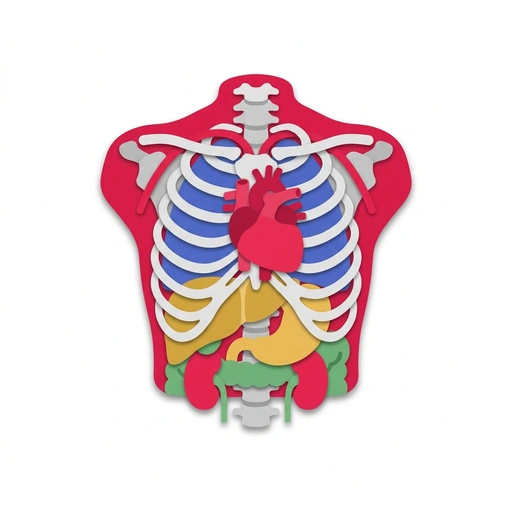
The Architecture of the Human Body
Understand how the human body really fits together, from bony landmarks and force-transmitting joints to visceral compartments and neurovascular routes.
Clinical Human Anatomy
Examine the topographical landmarks, fascial planes, and neurovascular crossroads that govern human function. Move beyond rote memorization to analyze structural vulnerabilities, collateral pathways, and clinical relationships.
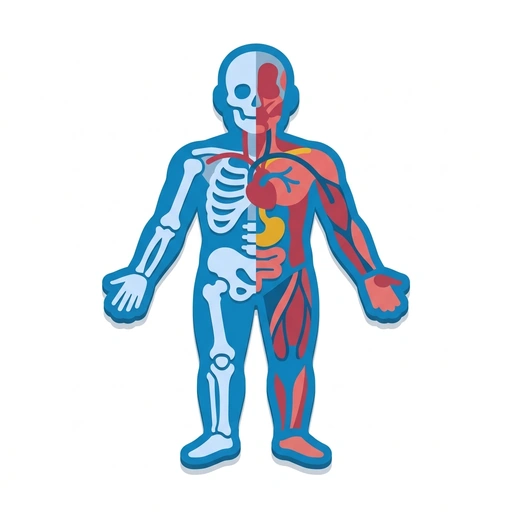
Human Anatomy: Form and Function
Bridge the gap between basic body parts and true functional anatomy. Discover how bones, muscles, nerves, and organs mechanically coordinate to sustain motion, regulate pressure, and maintain life.
Start Applied Human Anatomy today.
Download Tomo, search Applied Human Anatomy, and play your first lesson in under a minute.