
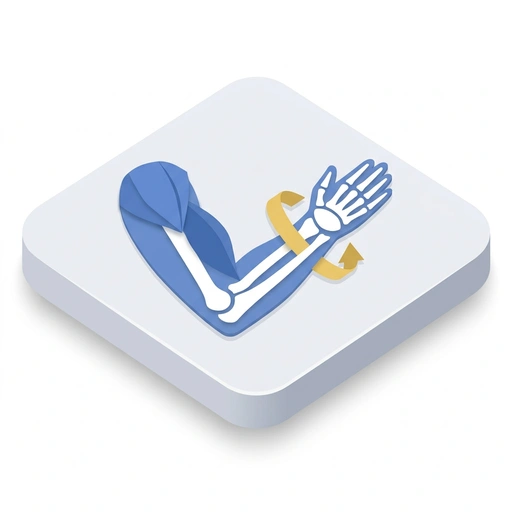
Bones, Muscles, and Movement
Go beyond naming parts to understand how the human frame generates power, maintains stability, and adapts to the physical world.
Like Duolingo, but for Bones, Muscles, and Movement. Tomo turns the whole topic into a game you play five minutes a day, until it actually sticks.
24 levels across 4 sections, about 48 minutes end to end, roughly 10 days at five minutes a day. It moves through The Mechanics of Motion, Structural Integrity, Performance and Control, and Growth and Adaptation. It assumes you already know the basics.
Free forever · No credit card · iPhone & Android

Key ideas in Bones, Muscles, and Movement
- Joints act as the fixed pivot point or fulcrum for movement
- Bones serve as the rigid levers that transmit muscle force
- The muscle's attachment site is where the effort is applied
- Identifying anatomical structures as lever components
- Third-class levers place the effort between the fulcrum and load
- This setup allows the hand to move a great distance very quickly
- The tradeoff is that the muscle must exert more force than the load
- Recognizing the functional tradeoff of third-class levers in the body
- A longer moment arm increases the leverage or torque potential
- Moving the insertion further from the joint eases the force requirement
- Proximally inserted muscles favor speed over raw strength
- Mechanical disadvantage amplifies the distance of the distal limb
- Small muscle shortening translates to large joint rotations
- The limb acts as a distance multiplier at the cost of force
- The angle of pull is most efficient when the muscle is perpendicular
- Understanding how insertion distance impacts torque
You've tried the other tabs
Thirty open tabs. Four facts you actually kept.
You watched. You nodded. By Sunday it was gone.
One answer, then back to scrolling.
Eight weeks. You meant to finish. You didn't.
Tomo gives Bones, Muscles, and Movement the Duolingo treatment: levels, streaks, and quick quizzes that test what you just learned. That game loop is what the tabs above never had, so it's the one you actually finish.
Here's what playing it feels like
A real question from this course. Take your best guess.
Where exactly is the 'effort' applied in a biological lever system?
Get it right to open this lesson and 23 more in the app.
Where Bones, Muscles, and Movement takes you
- 1
The Mechanics of Motion
- Levers and Mechanical Advantage
- Muscle Pairing and Coordination
- 2
Structural Integrity
- The Axial and Appendicular Relationship
- The Connective Tissue Web
- 3
Performance and Control
- Muscle Fiber Specialization
- Joint Range and Proprioception
- 4
Growth and Adaptation
- Bone Remodeling and Density
- Hypertrophy and Tissue Repair
4 sections · 8 units · 24 levels. Built to play, not to enroll.
Tomo is in ChatGPT
Tomo is also a ChatGPT plugin: the same playable courses, built and played inside your chat.
Add Tomo to ChatGPT- What to ask
- “Make me a Tomo course on black holes.” “Turn this chat into a Tomo course.”
- What you get
- Quick questions with instant feedback, hearts and stars, ready to play in about a minute.
- Where it goes
- No sign-up to start. Connect your Tomo account and your streak carries on in the app.
You pick the voice
Bones, Muscles, and Movement is taught in the Bestie style: your friend who just gets it. Want a different feel? In the app you can spin up the same topic in any of Tomo's teaching styles. Same facts, totally different vibe.
More Science on Tomo
Human Anatomy: Bones and Muscle
Move beyond memorizing muscle and bone names to understand how the human musculoskeletal system functions as an integrated mechanical machine. Learn how joints dictate movement, why muscles operate in coupled pairs, and how living tissue remodels under load.
Musculoskeletal Biomechanics
Examine how the human body turns tissue into mechanical power. Learn how bones, joints, and muscles operate as living lever systems, generate force across variable joint angles, and physically adapt to mechanical load.
Functional Human Anatomy
Bridge the gap between anatomical names and how the living body actually moves. Discover how bones, joints, muscles, and neural circuits collaborate to generate force and control motion.
Human Anatomy and Physiology in Practice
Go beyond basic diagrams to master the functional systems of the body. Learn how physiological mechanisms drive clinical diagnosis, natural healing, and peak human performance.
Anatomy: Bones, Muscles, and Nerves
Bridge the gap between memorizing isolated terms and understanding the human body as an integrated machine. Master skeletal landmarks, muscle attachment logic, and peripheral nerve pathways.
How the Human Body Is Built
Discover the physical architecture that keeps you moving, breathing, and alive. From the mechanical levers of your skeleton to the internal plumbing of your organs, learn to read the map of your own body with clarity and confidence.
Start Bones, Muscles, and Movement today.
Download Tomo, search Bones, Muscles, and Movement, and play your first lesson in under a minute.