

Bones of the Face and Body
Discover the names, shapes, and hidden engineering of the human skeleton. Learn to identify the bones across your face, limbs, and core, and see how they protect your organs and power everyday movement.
Like Duolingo, but for Bones of the Face and Body. Tomo turns the whole topic into a game you play five minutes a day, until it actually sticks.
21 levels across 4 sections, about 42 minutes end to end, roughly 8 days at five minutes a day. It moves through Finding Your Upper Landmarks, Weight Bearing and Locomotion, The Protective Core, and The Living Framework. It starts from scratch.
Free forever · No credit card · iPhone & Android

Key ideas in Bones of the Face and Body
- The mandible forms the lower jaw and chin
- Every other bone in the skull is locked in place except the mandible
- Chewing and speaking rely solely on the mandible hinged against the skull
- The zygomatic bone forms the high arch of the cheekbone
- The zygomatic bones form the outer and lower rim of the eye socket
- They connect the front of the face to the side of the skull
- The maxillae are two fused bones forming the central midface
- The maxillae secure the upper teeth and make up the floor of the nasal cavity
- The upper jaw does not move independently from the skull
- The frontal bone shapes the smooth curve of the forehead
- The thickened rim above the eyes acts like a built-in helmet visor protecting the eyeballs from top-down impacts
- It forms the upper roof of each eye socket
- Hollow sinus cavities keep the head light enough for neck muscles to hold up easily
- Air pockets act as echo chambers that give voice tone and resonance
- Solid bone throughout the face would make the front of the skull uncomfortably heavy
- The clavicle props the shoulder blade and arm out away from the rib cage like a rigid strut
You've tried the other tabs
Thirty open tabs. Four facts you actually kept.
You watched. You nodded. By Sunday it was gone.
One answer, then back to scrolling.
Eight weeks. You meant to finish. You didn't.
Tomo gives Bones of the Face and Body the Duolingo treatment: levels, streaks, and quick quizzes that test what you just learned. That game loop is what the tabs above never had, so it's the one you actually finish.
Here's what playing it feels like
A real question from this course. Take your best guess.
Which bone is the only one in your whole skull that can actually move around?
Get it right to open this lesson and 20 more in the app.
How to learn Bones of the Face and Body, step by step
Go in order. 21 short levels across 4 sections, about 42 minutes in all, five minutes a day.
- 1
Finding Your Upper Landmarks
- The Bones Beneath Your Face
- The Shoulder Girdle and Arms
- 2
Weight Bearing and Locomotion
- The Pelvic Girdle and Legs
- Hands and Feet: Grasping and Ground Strike
- 3
The Protective Core
- The Cranium and Deep Facial Skeleton
- The Spine and Rib Cage
- 4
The Living Framework
- Bone Architecture, Remodeling, and Healing
4 sections · 7 units · 21 levels. Built to play, not to enroll.
Questions about Bones of the Face and Body
How do I learn Bones of the Face and Body?
Go in order: start with Finding Your Upper Landmarks, then Weight Bearing and Locomotion, then The Protective Core, then The Living Framework. On Tomo that's 21 short levels, about 42 minutes in all, played five minutes a day. Start free and play the first level in under a minute.
Is there a Duolingo-style app for Bones of the Face and Body?
Yes. Tomo works like Duolingo: short daily lessons, streaks and quick quizzes. Bones of the Face and Body is one of its free courses, and you can type any other topic to get a course of your own.
Is the Bones of the Face and Body course free?
Yes. Bones of the Face and Body is playable on Tomo's free plan, which doesn't expire. No credit card, no waitlist. Download the app and start your first lesson.
How long does it take to learn Bones of the Face and Body?
21 levels across 4 sections, about 42 minutes of play in total. It's built for five minutes a day, so you finish it a little at a time instead of all at once.
Do I need any background to start Bones of the Face and Body?
No. It's pitched at a beginner level, so it starts where you are and builds up. If you can tap a phone, you can start.
Tomo is in ChatGPT
Tomo is also a ChatGPT plugin: the same playable courses, built and played inside your chat.
Add Tomo to ChatGPT- What to ask
- “Make me a Tomo course on black holes.” “Turn this chat into a Tomo course.”
- What you get
- Quick questions with instant feedback, hearts and stars, ready to play in about a minute.
- Where it goes
- No sign-up to start. Connect your Tomo account and your streak carries on in the app.
You pick the voice
Bones of the Face and Body is taught in the Explain Like I'm 5 style: no big words. promise.. Want a different feel? In the app you can spin up the same topic in any of Tomo's teaching styles. Same facts, totally different vibe.
More Science on Tomo
Human Anatomy: Bones and Muscle
Move beyond memorizing muscle and bone names to understand how the human musculoskeletal system functions as an integrated mechanical machine. Learn how joints dictate movement, why muscles operate in coupled pairs, and how living tissue remodels under load.
The Living Skeleton
Discover the dynamic, self-repairing world of your bones. Learn how your skeleton adapts to movement, acts as a living mineral vault, and stays strong for a lifetime.
How the Human Body Is Built
Decode the architecture beneath your skin. Learn to identify major skeletal landmarks, trace how muscles pull against joints, and understand how internal organs are organized into working compartments.
Human Muscle Anatomy
Discover how facial expressions, posture, and athletic movements actually work from the inside out. Learn the major muscle groups of the human body and the physiological mechanics behind every motion.
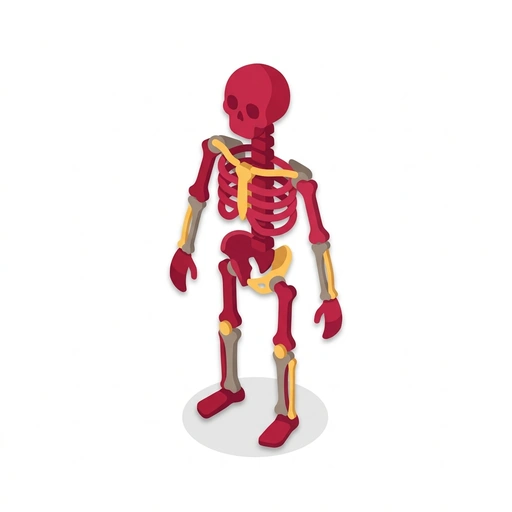
How the Human Body Fits Together
Explore the elegant architecture of your own body from the inside out. Learn how your skeleton, muscles, circulation, and vital organs coordinate to keep you upright, moving, and alive.
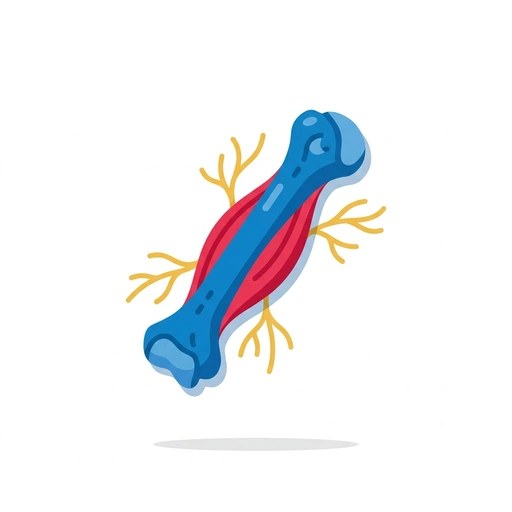
Anatomy: Bones, Muscles, and Nerves
Bridge the gap between memorizing isolated terms and understanding the human body as an integrated machine. Master skeletal landmarks, muscle attachment logic, and peripheral nerve pathways.
Start Bones of the Face and Body today.
Download Tomo, search Bones of the Face and Body, and play your first lesson in under a minute.