
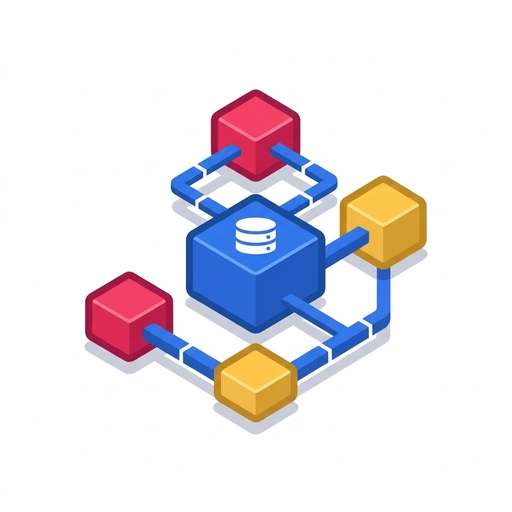
Designing Microservice Architectures
Move beyond the basics of monolithic code to build scalable, decoupled distributed systems. Master service boundaries, distributed data management, and resilience patterns required to run reliable microservices in production.
Like Duolingo, but for Designing Microservice Architectures. Tomo turns the whole topic into a game you play five minutes a day, until it actually sticks.
24 levels across 3 sections, about 48 minutes end to end, roughly 10 days at five minutes a day. It moves through Splitting Systems and Moving Data; Distributed Data and Consistency; and Resilience, Operations, and Evolution. It assumes you already know the basics.
Free forever · No credit card · iPhone & Android

Key ideas in Designing Microservice Architectures
- Aligning services by technical tier forces simple business changes to touch every layer.
- Capability-aligned services package their own logic and data store to deploy independently.
- Horizontal scaling becomes brittle when technical layers share runtime release cadences.
- A bounded context isolates a domain model so terms have a single unambiguous meaning.
- Polysemic concepts like 'Product' require different schemas in catalog versus warehouse contexts.
- Forcing a universal enterprise data model creates high runtime and development coupling.
- Subdividing below cohesive business capabilities produces tightly coupled nanoservices.
- Healthy service boundaries mirror autonomous team ownership and isolated deployment lifecycles.
- Nanoservices increase network latency and require brittle, coordinated lockstep releases.
- An anti-corruption layer translates external schemas into native domain objects at the boundary.
- Consuming legacy payloads directly pollutes modern domain logic with archaic data quirks.
- Translation layers allow downstream services to evolve clean interfaces independently.
- Duplicating business algorithms across services creates brittle semantic coupling during rule updates.
- Sharing direct database access bypasses service boundaries and couples internal schemas.
- Implicit domain assumptions like encoded identifier structures couple services without code imports.
- Synchronous calls block caller threads until the downstream service finishes responding.
You've tried the other tabs
Thirty open tabs. Four facts you actually kept.
You watched. You nodded. By Sunday it was gone.
One answer, then back to scrolling.
Eight weeks. You meant to finish. You didn't.
Tomo gives Designing Microservice Architectures the Duolingo treatment: levels, streaks, and quick quizzes that test what you just learned. That game loop is what the tabs above never had, so it's the one you actually finish.
Here's what playing it feels like
A real question from this course. Take your best guess.
What allows a capability-aligned service to be deployed completely on its own schedule?
Get it right to open this lesson and 23 more in the app.
How to learn Designing Microservice Architectures, step by step
Go in order. 24 short levels across 3 sections, about 48 minutes in all, five minutes a day.
- 1
Splitting Systems and Moving Data
- Carving Clean Service Boundaries
- Structuring Synchronous and Asynchronous Communication
- 2
Distributed Data and Consistency
- Managing Isolated Databases per Service
- Coordinating Transactions Across Services with Sagas
- Querying Distributed Data with CQRS and Read Models
- 3
Resilience, Operations, and Evolution
- Defending Against Cascading System Failures
- Observability and Traffic Routing at the Edge
- Migrating Monoliths with the Strangler Pattern
3 sections · 8 units · 24 levels. Built to play, not to enroll.
Questions about Designing Microservice Architectures
How do I learn Designing Microservice Architectures?
Go in order: start with Splitting Systems and Moving Data, then Distributed Data and Consistency, then Resilience, Operations, and Evolution. On Tomo that's 24 short levels, about 48 minutes in all, played five minutes a day. Start free and play the first level in under a minute.
Is there a Duolingo-style app for Designing Microservice Architectures?
Yes. Tomo works like Duolingo: short daily lessons, streaks and quick quizzes. Designing Microservice Architectures is one of its free courses, and you can type any other topic to get a course of your own.
Is the Designing Microservice Architectures course free?
Yes. Designing Microservice Architectures is playable on Tomo's free plan, which doesn't expire. No credit card, no waitlist. Download the app and start your first lesson.
How long does it take to learn Designing Microservice Architectures?
24 levels across 3 sections, about 48 minutes of play in total. It's built for five minutes a day, so you finish it a little at a time instead of all at once.
Do I need any background to start Designing Microservice Architectures?
No. It's pitched at an intermediate level, so it starts where you are and builds up. If you can tap a phone, you can start.
Tomo is in ChatGPT
Tomo is also a ChatGPT plugin: the same playable courses, built and played inside your chat.
Add Tomo to ChatGPT- What to ask
- “Make me a Tomo course on black holes.” “Turn this chat into a Tomo course.”
- What you get
- Quick questions with instant feedback, hearts and stars, ready to play in about a minute.
- Where it goes
- No sign-up to start. Connect your Tomo account and your streak carries on in the app.
You pick the voice
Designing Microservice Architectures is taught in the Professor style: clear, structured, thorough. Want a different feel? In the app you can spin up the same topic in any of Tomo's teaching styles. Same facts, totally different vibe.
More Technology on Tomo
Building with Next.js
Transform your React skills into production-grade full-stack web applications. Learn how Next.js handles routing, server rendering, streaming, and data mutations without complex backend setups.

AI Agents at Work
Learn how AI agents move beyond simple conversation to solve problems, use external tools, and automate complex multi-step tasks on your behalf.

How Relational Databases Work
Move beyond static spreadsheets to understand how relational databases structure, connect, and retrieve data. Learn to formulate precise queries, design clean relational schemas, and protect data integrity under heavy traffic.
Designing Software Systems
Learn how to turn messy business problems into clear, structured software blueprints. Master user story mapping, interactive wireframing, process modeling, and data architecture to design systems developers can build with precision.
How Computer Networks Move Data
Bridge the gap between everyday network terms and how traffic actually moves through the internet. Learn to trace packets across switches, routers, and firewalls while demystifying transport protocols and the models that govern them.

The AI Data Scientist Interview
Tackle open-ended machine learning case studies, production system designs, and diagnostic live rounds. Learn to translate ambiguous business requirements into robust models, avoid common data pitfalls, and defend your engineering tradeoffs with confidence.
Start Designing Microservice Architectures today.
Download Tomo, search Designing Microservice Architectures, and play your first lesson in under a minute.