
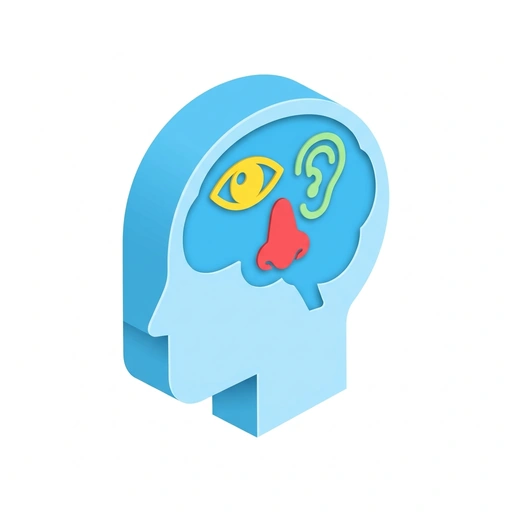
How Senses Construct Reality
Your conscious experience feels like a direct window onto the physical world, but it is actually a calibrated simulation built from ambiguous neural signals. Learn how your brain weighs top-down expectations against noisy sensory data across vision, hearing, and touch. Unpack the mechanics of perceptual thresholds, cross-modal integration, and sensory illusions.
Like Duolingo, but for How Senses Construct Reality. Tomo turns the whole topic into a game you play five minutes a day, until it actually sticks.
A short one: 12 levels across 2 sections, about 24 minutes end to end, roughly 5 days at five minutes a day. It moves through Interrogating Your Immediate Senses and The Architecture of Perceptual Synthesis. It assumes you already know the basics.
Free forever · No credit card · iPhone & Android

Key ideas in How Senses Construct Reality
- High-acuity vision covers only about two degrees of the visual field at the fovea.
- Peripheral retina trades fine spatial detail for motion sensitivity and coarse shape detection.
- The brain creates a false impression of full-field clarity by darting the fovea around.
- The visual system temporarily suppresses input during rapid ballistic eye movements called saccades.
- Saccadic suppression blocks the perception of continuous motion blur while the eye darts.
- Because visual processing is suppressed during the transit, you cannot see your own saccades in a mirror.
- The optic disc lacks photoreceptors where the optic nerve exits the eyeball.
- Rather than leaving a black hole, the visual cortex fills the gap using surrounding patterns and colors.
- Active perceptual interpolation seamlessly bridges collinear lines across the blind spot.
- Color constancy calculates object reflectance by comparing light spectra across the whole visual scene.
- The cortex discounts the color of the ambient light source to deduce an object's true hue.
- Without contrasting surfaces or shadow boundaries, the visual system cannot reliably discount illumination.
- Change blindness occurs when a brief visual disruption masks the transient signal that normally attracts attention.
- Conscious visual awareness encodes meaning and task relevance rather than pixel-by-pixel scene details.
- Without an explicit attention cue or uninterrupted motion transient, large visual shifts go unnoticed.
- Sensitivity reflects sensory hardware acuity, while criterion reflects the bias for reporting a signal.
You've tried the other tabs
Thirty open tabs. Four facts you actually kept.
You watched. You nodded. By Sunday it was gone.
One answer, then back to scrolling.
Eight weeks. You meant to finish. You didn't.
Tomo gives How Senses Construct Reality the Duolingo treatment: levels, streaks, and quick quizzes that test what you just learned. That game loop is what the tabs above never had, so it's the one you actually finish.
Here's what playing it feels like
A real question from this course. Take your best guess.
Look straight at a single letter on this screen. How much of what you see around it is truly sharp and crystal clear?
Get it right to open this lesson and 11 more in the app.
Where How Senses Construct Reality takes you
- 1
Interrogating Your Immediate Senses
- Seeing Past the Visual Illusion
- Calibrating Sensitivity and Decision Thresholds
- 2
The Architecture of Perceptual Synthesis
- Cross-Modal Binding and Sensory Substitution
- The Predictive Brain and Controlled Hallucination
2 sections · 4 units · 12 levels. Built to play, not to enroll.
Tomo is in ChatGPT
Tomo is also a ChatGPT plugin: the same playable courses, built and played inside your chat.
Add Tomo to ChatGPT- What to ask
- “Make me a Tomo course on black holes.” “Turn this chat into a Tomo course.”
- What you get
- Quick questions with instant feedback, hearts and stars, ready to play in about a minute.
- Where it goes
- No sign-up to start. Connect your Tomo account and your streak carries on in the app.
You pick the voice
How Senses Construct Reality is taught in the Explain Like I'm 5 style: no big words. promise.. Want a different feel? In the app you can spin up the same topic in any of Tomo's teaching styles. Same facts, totally different vibe.
More Science on Tomo

How Minds Measure Reality
Discover the hidden math and physics running your senses. Learn why your nervous system measures physical energy in ratios, how to filter signal from noise, and why perception is an exercise in probability.

The Physics of Your Senses
Discover how your brain translates the raw forces of the universe—like light waves and gravity—into the world you actually experience.

Quantum Realities: Time and Parallel Worlds
Move beyond science fiction to explore the rigorous physics of the multiverse, retrocausality, and the mathematical possibility of time travel. Master the mechanics of how reality branches and how time behaves at the quantum scale.

Your Body's Blueprint
Discover the incredible engineering of the human body, from the electrical signals in your brain to the living architecture of your bones.
The Biology of Attraction
Discover the hidden chemical and neurological forces that drive human connection, from the first spark of a glance to the deep bonds of long-term partnership.

Mapping the Human Brain
Explore the architecture of the mind from the wrinkly outer cortex to the deep survival core. Learn where memories, senses, and motor habits live, and trace how distinct regions collaborate to produce everyday experience.
Start How Senses Construct Reality today.
Download Tomo, search How Senses Construct Reality, and play your first lesson in under a minute.