
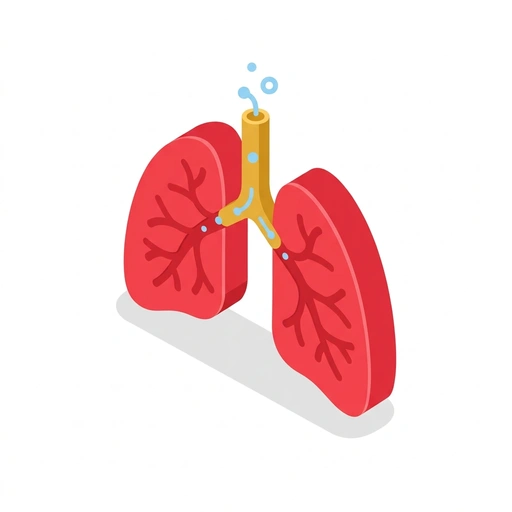
How Your Lungs Work
Discover the hidden engine behind every breath. Learn how your body captures air, powers your blood, and how you can use breathing to control your energy and stress.
Like Duolingo, but for How Your Lungs Work. Tomo turns the whole topic into a game you play five minutes a day, until it actually sticks.
A short one: 12 levels across 2 sections, about 24 minutes end to end, roughly 5 days at five minutes a day. It moves through The Mechanics of Breathing and Mastering Your Airflow. It starts from scratch.
Free forever · No credit card · iPhone & Android
Key ideas in How Your Lungs Work
- Lungs are passive tissue similar to balloons
- The diaphragm acts as the floor of the chest cavity
- Lungs lack the muscle fibers to move themselves
- The diaphragm moves downward toward the stomach to inhale
- Lungs rely on external pressure changes to expand
- Moving the diaphragm down creates a vacuum in the chest
- The mechanical action of the diaphragm
- Belly breathing moves the organs out of the way so the lungs can stretch downward
- Chest breathing is restricted by the rigid structure of the upper ribs
- Lung tissue is elastic and naturally wants to shrink back
- Exhaling during rest doesn't require muscle effort
- The physics of a relaxed exhale
- The rib cage provides a rigid frame that protects the lungs
- Why belly breathing is more effective for lung capacity
- Ribs move up and out like a bucket handle to increase lung volume
- Rib movement is essential for maximizing air intake
You've tried the other tabs
Thirty open tabs. Four facts you actually kept.
You watched. You nodded. By Sunday it was gone.
One answer, then back to scrolling.
Eight weeks. You meant to finish. You didn't.
Tomo gives How Your Lungs Work the Duolingo treatment: levels, streaks, and quick quizzes that test what you just learned. That game loop is what the tabs above never had, so it's the one you actually finish.
Here's what playing it feels like
A real question from this course. Take your best guess.
Where is the diaphragm located in relation to your chest cavity?
Get it right to open this lesson and 11 more in the app.
Where How Your Lungs Work takes you
- 1
The Mechanics of Breathing
- How You Actually Move Air
- The Great Gas Exchange
- 2
Mastering Your Airflow
- Taking the Controls
- Protecting the Filter
2 sections · 4 units · 12 levels. Built to play, not to enroll.
Tomo is in ChatGPT
Tomo is also a ChatGPT plugin: the same playable courses, built and played inside your chat.
Add Tomo to ChatGPT- What to ask
- “Make me a Tomo course on black holes.” “Turn this chat into a Tomo course.”
- What you get
- Quick questions with instant feedback, hearts and stars, ready to play in about a minute.
- Where it goes
- No sign-up to start. Connect your Tomo account and your streak carries on in the app.
You pick the voice
How Your Lungs Work is taught in the Bestie style: your friend who just gets it. Want a different feel? In the app you can spin up the same topic in any of Tomo's teaching styles. Same facts, totally different vibe.
More Health on Tomo
How Your Body Fits Together
Discover the brilliant engineering beneath your skin. Learn how your bones, muscles, organs, and nerves connect and collaborate to keep you moving, breathing, and alive.
The Human Body in Care Work
Understand how the human body functions, breaks down, and heals through the practical lens of caregiving. Learn to interpret vital signals, safeguard fragile skin, and support mobility with anatomical confidence.
How Human Diseases Work
Explore how the human body breaks down across major medical specialties, from heart attacks and strokes to auto-immunity and cancer. Learn the biological mechanisms behind common symptoms and how modern medicine diagnoses and fights back.
Human Anatomy for Patient Care
Learn the essential structures and functional systems of the human body through a practical clinical lens. Understand how organs interact, where vital landmarks sit, and why anatomical knowledge forms the foundation of frontline healthcare.
Clinical Anatomy: The Body in Action
Master the structural logic of the human body through the lens of clinical practice. Learn to visualize internal systems and speak the precise language used by medical professionals to describe health and injury.
How Your Brain Runs Your Body
Understand the hidden biological signals that control your daily focus, mood, and stamina. Learn how your nervous system talks to your organs and how to use simple physical levers to feel better every day.
Start How Your Lungs Work today.
Download Tomo, search How Your Lungs Work, and play your first lesson in under a minute.