
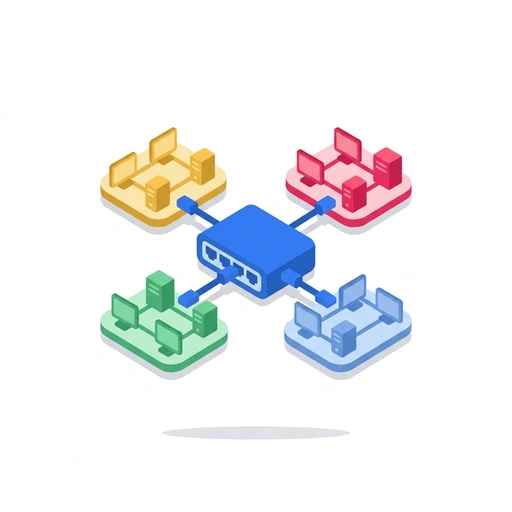
IP Subnetting and Network Design
Move beyond slow binary charts to calculate network ranges in seconds. Design efficient subnets using VLSM, audit routing boundaries, and summarize routes like an experienced network engineer.
Like Duolingo, but for IP Subnetting and Network Design. Tomo turns the whole topic into a game you play five minutes a day, until it actually sticks.
21 levels across 4 sections, about 42 minutes end to end, roughly 8 days at five minutes a day. It moves through Mental Math and Instant Calculation, Designing Efficient Networks with VLSM, Auditing Boundaries and Routing Problems, and Next-Generation Addressing and Scale. It assumes you already know the basics.
Free forever · No credit card · iPhone & Android
Key ideas in IP Subnetting and Network Design
- The interesting octet is the only octet containing a value other than 255 or 0.
- Octets with 255 stay identical to the original IP, while octets with 0 default to all zeros or all ones.
- Subtract the mask value in the interesting octet from 256 to find the magic number.
- The magic number directly defines the block size, or total IP increment per subnet.
- Network IDs in the interesting octet are always exact multiples of the magic number.
- To find an IP's network ID, pick the highest multiple that is less than or equal to that IP.
- The next multiple minus one marks the broadcast address for that subnet block.
- The first usable host is strictly one address above the network ID.
- The last usable host is strictly one address below the broadcast address.
- Two raised to the power of remaining host bits in an octet equals the magic number.
- Memorizing 2^6 = 64 instantly yields the block size for /26 without decimal conversion.
- CIDR prefix length counts contiguous mask bits set to 1 strictly from the most significant bit on the left
- A valid subnet mask cannot have 0s interspersed between 1s because prefix routing requires unbroken boundaries
- The remaining bits after the prefix length determine the host portion of the address block
- A dotted-decimal mask converts each 8-bit octet into decimal, mirroring the exact binary 1s of a CIDR prefix
- The prefix /25 adds one leading bit (128) into the fourth octet, yielding 255.255.255.128
You've tried the other tabs
Thirty open tabs. Four facts you actually kept.
You watched. You nodded. By Sunday it was gone.
One answer, then back to scrolling.
Eight weeks. You meant to finish. You didn't.
Tomo gives IP Subnetting and Network Design the Duolingo treatment: levels, streaks, and quick quizzes that test what you just learned. That game loop is what the tabs above never had, so it's the one you actually finish.
Here's what playing it feels like
A real question from this course. Take your best guess.
In the subnet mask 255.255.240.0, which octet is the "interesting octet" where calculations take place?
Get it right to open this lesson and 20 more in the app.
How to learn IP Subnetting and Network Design, step by step
Go in order. 21 short levels across 4 sections, about 42 minutes in all, five minutes a day.
- 1
Mental Math and Instant Calculation
- Fast Subnetting with the Magic Number
- Translating Masks, CIDR, and Wildcard Masks
- 2
Designing Efficient Networks with VLSM
- Sizing Subnets with Variable Length Subnet Masking
- Allocating Point-to-Point Links and Host Pools
- 3
Auditing Boundaries and Routing Problems
- Diagnosing Overlapping Subnets and Off-by-One Ranges
- Route Summarization and Supernetting
- 4
Next-Generation Addressing and Scale
- IPv6 Subnetting and Nibble Boundaries
4 sections · 7 units · 21 levels. Built to play, not to enroll.
Questions about IP Subnetting and Network Design
How do I learn IP Subnetting and Network Design?
Go in order: start with Mental Math and Instant Calculation, then Designing Efficient Networks with VLSM, then Auditing Boundaries and Routing Problems, then Next-Generation Addressing and Scale. On Tomo that's 21 short levels, about 42 minutes in all, played five minutes a day. Start free and play the first level in under a minute.
Is there a Duolingo-style app for IP Subnetting and Network Design?
Yes. Tomo works like Duolingo: short daily lessons, streaks and quick quizzes. IP Subnetting and Network Design is one of its free courses, and you can type any other topic to get a course of your own.
Is the IP Subnetting and Network Design course free?
Yes. IP Subnetting and Network Design is playable on Tomo's free plan, which doesn't expire. No credit card, no waitlist. Download the app and start your first lesson.
How long does it take to learn IP Subnetting and Network Design?
21 levels across 4 sections, about 42 minutes of play in total. It's built for five minutes a day, so you finish it a little at a time instead of all at once.
Do I need any background to start IP Subnetting and Network Design?
No. It's pitched at an intermediate level, so it starts where you are and builds up. If you can tap a phone, you can start.
Tomo is in ChatGPT
Tomo is also a ChatGPT plugin: the same playable courses, built and played inside your chat.
Add Tomo to ChatGPT- What to ask
- “Make me a Tomo course on black holes.” “Turn this chat into a Tomo course.”
- What you get
- Quick questions with instant feedback, hearts and stars, ready to play in about a minute.
- Where it goes
- No sign-up to start. Connect your Tomo account and your streak carries on in the app.
You pick the voice
IP Subnetting and Network Design is taught in the Professor style: clear, structured, thorough. Want a different feel? In the app you can spin up the same topic in any of Tomo's teaching styles. Same facts, totally different vibe.
More Technology on Tomo
How Quantum Networks Work
Learn how quantum mechanics enables tamper-evident communication and distributed entanglement across distances. Understand the engineering behind QKD, entanglement swapping, quantum memories, and routing protocols.
How Computer Networks Move Data
Bridge the gap between everyday network terms and how traffic actually moves through the internet. Learn to trace packets across switches, routers, and firewalls while demystifying transport protocols and the models that govern them.

The Digital Architect: From Pixels to Packets
Master the invisible systems that power our world. Move beyond basic usage to understand how data travels, how users think, and how complex software stays standing under pressure.
Designing Your First PCB
Turn your breadboard sketches into clean, manufacturable printed circuit boards. Learn schematic capture, trace routing, ground planes, and production file generation.
Build Your Own Home Lab
Move beyond basic Wi-Fi and start building professional-grade networks on your laptop. Learn to architect virtual environments, secure traffic with firewalls, and master the protocols that power the global internet.
The AI Data Scientist Interview
Tackle open-ended machine learning case studies, production system designs, and diagnostic live rounds. Learn to translate ambiguous business requirements into robust models, avoid common data pitfalls, and defend your engineering tradeoffs with confidence.
Start IP Subnetting and Network Design today.
Download Tomo, search IP Subnetting and Network Design, and play your first lesson in under a minute.