
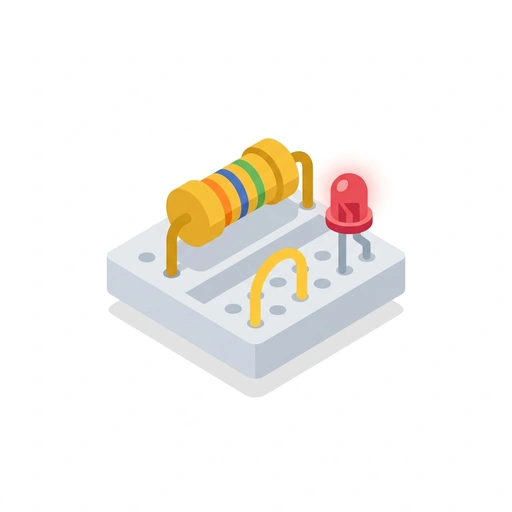
Mastering the Flow: Practical Electronics
Like Duolingo, but for Mastering the Flow: Practical Electronics. Tomo turns the whole topic into a game you play five minutes a day, until it actually sticks.
For the part of you with thirty open tabs that never became anything.
185 levels across 8 sections, about 370 minutes end to end, roughly 74 days at five minutes a day. It moves through Building Circuits That Work, Managing Power and Energy, Storing and Timing Energy, Switching and Amplifying, Interfacing with the Real World, The Logic of Modern Electronics, Troubleshooting and Refinement, and The Physics of the Flow. It assumes you already know the basics.
Free forever · No credit card · iPhone & Android

Key ideas in Mastering the Flow: Practical Electronics
- Voltage acts as the initial push or pressure
- Current is the measurable movement of electricity
- Resistance is the force that opposes movement
- Higher resistance makes it harder for electricity to pass
- Increasing friction reduces the total current flow
- Distinguishing between the roles of pressure, flow, and friction in a circuit
- Predicting the effect of increasing resistance on current
- Voltage is the pressure that overcomes obstacles
- Higher pressure can force flow through high-resistance barriers
- Current is highest when pressure is high and friction is low
- High friction can choke out even a strong pressure source
- Understanding the danger of high voltage sources
- Predicting flow levels based on circuit components
- Consequences of a short circuit
- How components work together
- Current increases proportionally with voltage
You've tried the other tabs
Thirty open tabs. Four facts you actually kept.
You watched. You nodded. By Sunday it was gone.
One answer, then back to scrolling.
Eight weeks. You meant to finish. You didn't.
Tomo gives Mastering the Flow: Practical Electronics the Duolingo treatment: levels, streaks, and quick quizzes that test what you just learned. That game loop is what the tabs above never had, so it's the one you actually finish.
Here's what playing it feels like
A real question from this course. Take your best guess.
When we talk about the actual volume of electricity moving through a wire, what are we describing?
Get it right to open this lesson and 184 more in the app.
Where Mastering the Flow: Practical Electronics takes you
Move beyond simple batteries and bulbs to design circuits that solve real problems. Master the math of power, troubleshoot like a pro, and understand how modern gadgets actually think.
- 1
Building Circuits That Work
- The Golden Rule: Voltage, Current, and Resistance
- Calculating Resistance for Component Safety
- Breadboarding Without the Mess
- Measuring Reality with a Multimeter
- Identifying Common Connection Failures
- 2
Managing Power and Energy
- The Math of Heat: Calculating Wattage
- Batteries in Series vs. Parallel
- Voltage Dividers: Getting the Right Pressure
- Regulating Power for Sensitive Parts
- 3
Storing and Timing Energy
- Capacitors: The Circuit's Water Towers
- Smoothing Out Noisy Power Signals
- Timing Circuits and Charge Rates
- Safety First: Discharging Large Capacitors
- Choosing the Right Capacitor Material
- Inductors and Magnetic Energy Storage
- 4
Switching and Amplifying
- Transistors as Electronic Switches
- The Math of Gain: Making Small Signals Big
- Driving High-Power Loads with Low-Power Pins
- Protecting Circuits from Back-Voltage
- 5
Interfacing with the Real World
- Reading Light, Heat, and Pressure Sensors
- Cleaning Up Bouncy Button Signals
- Controlling Motors and Moving Parts
- Using Relays for High-Voltage Isolation
- Visual Feedback: Beyond the Simple LED
- 6
The Logic of Modern Electronics
- Binary Thinking: Highs and Lows
- Combining Signals with Logic Gates
- Integrated Circuits: The Black Box Revolution
- Pull-up and Pull-down Resistor Essentials
- 7
Troubleshooting and Refinement
- Tracing Signals to Find the Break
- Dealing with Interference and Noise
- The Art of Clean Soldering
- Reading and Drawing Professional Schematics
- Prototyping: From Breadboard to Permanent Board
- 8
The Physics of the Flow
- How Electrons Actually Move
- Alternating vs. Direct Current Mechanics
- Semiconductor Chemistry and P-N Junctions
- The History of the Vacuum Tube to Silicon
8 sections · 37 units · 185 levels. Built to play, not to enroll.
You pick the voice
Mastering the Flow: Practical Electronics is taught in the The Bestie style: your friend who just gets it. Want a different feel? In the app you can spin up the same topic in any of Tomo's teaching styles. Same facts, totally different vibe.
More Technology on Tomo
Electronics and Coding with Raspberry Pi
Stop just reading about circuits and start building them. Learn to control the physical world with code, from blinking your first light to designing smart home gadgets.

Build Your Own Power Tool Speaker
Transform your spare power tool batteries into a high-performance portable sound system. Learn to wire step-down converters and build a rugged speaker that lasts all day on a single charge.
The Flow of Power
Stop guessing and start building. Learn to see electricity as a flowing current you can direct, control, and use to bring your own gadgets to life.

Transistors: The Switches That Think
Discover how a tiny piece of silicon acts as a digital gatekeeper, turning simple electrical pulses into the complex logic that powers every computer on Earth.

Mastering the Magic of Spreadsheets
Stop fighting with rows and columns and start making them work for you. Learn to organize your life, automate your math, and turn messy data into clear answers in minutes.
Inside the Machine: Mastering Computer Hardware and Networking
Go beyond basic setup to understand how modern hardware communicates and solves complex problems. Learn to diagnose deep-seated system issues and build robust local networks from the ground up.
Start Mastering the Flow: Practical Electronics today.
Download Tomo, search Mastering the Flow: Practical Electronics, and play your first lesson in under a minute.