
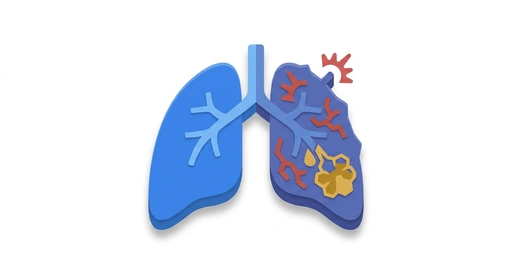
Respiratory Pathophysiology
Like Duolingo, but for Respiratory Pathophysiology. Tomo turns the whole topic into a game you play five minutes a day, until it actually sticks.
For the part of you with thirty open tabs that never became anything.
71 levels across 8 sections, about 142 minutes end to end, roughly 28 days at five minutes a day. It moves through Clinical Signs and Breathing Rhythms, Obstructive Airway Pathologies, Restrictive and Interstitial Disorders, Pulmonary Vascular Pathophysiology, Infection and Acute Lung Injury, Pleural Space and Mechanics, Gas Exchange and Acid-Base Mastery, and Advanced Diagnostics and Neoplasia. It assumes you already know the basics.
Free forever · No credit card · iPhone & Android
Key ideas in Respiratory Pathophysiology
- Accessory muscle recruitment
- Tripod position mechanics
- Metabolic cost of breathing
- Diaphragm excursion in tripod position
- Cyanosis is caused by the absolute amount of deoxygenated hemoglobin
- Tachypnea is the body's fastest way to increase minute ventilation
- Significance of accessory muscle recruitment
- Central cyanosis indicates a systemic failure of gas exchange
- Mechanical advantage of the tripod position
- Identifying the physiological trigger for central cyanosis
- Grunting is an expiratory sound against a closed glottis to maintain lung volume
- Tachypnea is the body's fastest way to increase minute ventilation and maintain CO2 balance
- Nasal flaring is a reflex to widen the narrowest part of the pediatric airway
- Cyanosis is caused by the absolute amount of deoxygenated hemoglobin, not just a low oxygen percentage
- Distinguishing pediatric-specific markers of airway resistance
- Delayed circulation slows the time it takes for CO2 changes to reach brain sensors
You've tried the other tabs
Thirty open tabs. Four facts you actually kept.
You watched. You nodded. By Sunday it was gone.
One answer, then back to scrolling.
Eight weeks. You meant to finish. You didn't.
Tomo gives Respiratory Pathophysiology the Duolingo treatment: levels, streaks, and quick quizzes that test what you just learned. That game loop is what the tabs above never had, so it's the one you actually finish.
Here's what playing it feels like
A real question from this course. Take your best guess.
How does the tripod position help a patient who is struggling to breathe?
Get it right to open this lesson and 70 more in the app.
Where Respiratory Pathophysiology takes you
Master the mechanisms of lung disease, from cellular gas exchange failures to the clinical recognition of complex breathing patterns and obstructive disorders.
- 1
Clinical Signs and Breathing Rhythms
- Decoding Respiratory Distress
- Rhythms of Respiratory Dysfunction
- 2
Obstructive Airway Pathologies
- Asthma: The Hyper-responsive Airway
- COPD: Chronic Bronchitis and Emphysema
- Bronchiectasis and Cystic Fibrosis
- 3
Restrictive and Interstitial Disorders
- Interstitial Lung Disease and Fibrosis
- Extrapulmonary Restriction
- 4
Pulmonary Vascular Pathophysiology
- Pulmonary Embolism and Infarction
- Pulmonary Hypertension and Cor Pulmonale
- Pulmonary Edema: Pressure vs. Permeability
- 5
Infection and Acute Lung Injury
- Pneumonia: Consolidation and Gas Exchange
- ARDS: The Alveolar Cytokine Storm
- 6
Pleural Space and Mechanics
- Pleural Effusions and Pleurisy
- Pneumothorax: Tension and Collapse
- 7
Gas Exchange and Acid-Base Mastery
- V/Q Mismatching and Shunts
- Respiratory Acid-Base Balance
- 8
Advanced Diagnostics and Neoplasia
- Interpreting Pulmonary Function Tests
- Lung Cancer and Paraneoplastic Syndromes
8 sections · 18 units · 71 levels. Built to play, not to enroll.
You pick the voice
Respiratory Pathophysiology is taught in the The Professor style: clear, structured, thorough. Want a different feel? In the app you can spin up the same topic in any of Tomo's teaching styles. Same facts, totally different vibe.
More Science on Tomo
Human Anatomy and Physiology in Practice
Go beyond basic diagrams to master the functional systems of the body. Learn how physiological mechanisms drive clinical diagnosis, natural healing, and peak human performance.
Human Anatomy and Physiology
Go beyond basic diagrams to master the complex mechanical and chemical interactions that sustain human life. This course bridges the gap between structural form and clinical function for a professional-grade understanding of the body.
The Architecture of Life: Advanced Reproductive Science
Master the complex biological systems and hormonal feedback loops that drive human reproduction. From the precision of gametogenesis to the intricate signaling of the gestational environment, explore the science of how life begins.

Gravity's Extremes: From Big Bang to Black Holes
Explore how the curvature of spacetime dictates the birth of the universe and the mysterious physics of its most dense objects.
The Rules of the Physical World
Discover the invisible forces that govern everything from your morning walk to the stars above. Learn to see the world through the lens of motion, energy, and gravity.

The Tilted Earth: Why We Don't Fall Over
Discover the invisible forces that keep our planet steady and what would happen if our world-shaping tilt ever slipped.
Start Respiratory Pathophysiology today.
Download Tomo, search Respiratory Pathophysiology, and play your first lesson in under a minute.