
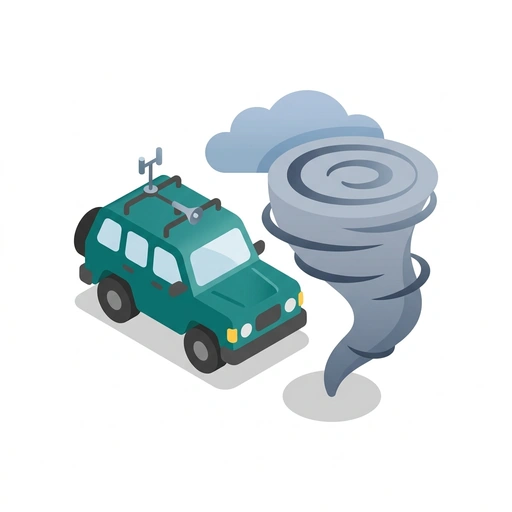
Storm Chasing Meteorology
Learn to read towering storm clouds, interpret live Doppler radar, and safely position yourself near tornadic supercells. Build the core meteorological knowledge required to understand and chase severe weather.
Like Duolingo, but for Storm Chasing Meteorology. Tomo turns the whole topic into a game you play five minutes a day, until it actually sticks.
24 levels across 4 sections, about 48 minutes end to end, roughly 10 days at five minutes a day. It moves through Reading the Sky in the Field, Mobile Radar and Tactical Navigation, The Severe Weather Recipe, and Vortex Evolution and Chase Realities. It starts from scratch.
Free forever · No credit card · iPhone & Android

Key ideas in Storm Chasing Meteorology
- The dark, flat cloud base with no rain falling beneath it is the storm's main updraft intake
- Warm, humid surface air rushes upward into the storm at the rain-free base
- Tornadoes and wall clouds descend from the rain-free updraft base, not from the heavy rain core
- Grooves and striations carved around the main updraft tower show twisting air currents
- A rotating updraft turns an ordinary storm into a supercell
- Smooth, untextured clouds indicate air simply rising straight up without spin
- The forward flank dumps massive curtains of rain and giant hail to the north and east
- Rain and hail are cast away from the updraft, keeping the southern flank rain-free and visible
- Approaching from the rain core blocks your visual line of sight and puts you in damaging hail
- Shelf clouds look dramatic and scary, but they mark outflow pushing away from the storm
- Tornadic features feed on inflow, pulling warm air inward and upward toward the center
- Feeling a blast of cold wind means outflow has arrived, signaling the storm is venting, not sucking in
- Beaver tails and inflow bands are flat streams of condensation marking rivers of warm air feed
- These bands point like direct arrows into the storm's rotating updraft base
- They indicate the storm is actively consuming lots of warm, humid surface air
- Scud clouds are detached, ragged, and drift loosely past the storm
You've tried the other tabs
Thirty open tabs. Four facts you actually kept.
You watched. You nodded. By Sunday it was gone.
One answer, then back to scrolling.
Eight weeks. You meant to finish. You didn't.
Tomo gives Storm Chasing Meteorology the Duolingo treatment: levels, streaks, and quick quizzes that test what you just learned. That game loop is what the tabs above never had, so it's the one you actually finish.
Here's what playing it feels like
A real question from this course. Take your best guess.
What kind of air rushes upward into the storm at the rain-free base?
Get it right to open this lesson and 23 more in the app.
How to learn Storm Chasing Meteorology, step by step
Go in order. 24 short levels across 4 sections, about 48 minutes in all, five minutes a day.
- 1
Reading the Sky in the Field
- Visual Anatomy of a Supercell
- Spotting Wall Clouds and Imminent Rotation
- 2
Mobile Radar and Tactical Navigation
- Interpreting Mobile Radar Signatures
- Positioning and Escape Strategy
- 3
The Severe Weather Recipe
- Atmospheric Ingredients for Tornadogenesis
- Targeting the Initiation Zone
- 4
Vortex Evolution and Chase Realities
- The Tornado Life Cycle
- Field Hazards and Chaser Ethics
4 sections · 8 units · 24 levels. Built to play, not to enroll.
Questions about Storm Chasing Meteorology
How do I learn Storm Chasing Meteorology?
Go in order: start with Reading the Sky in the Field, then Mobile Radar and Tactical Navigation, then The Severe Weather Recipe, then Vortex Evolution and Chase Realities. On Tomo that's 24 short levels, about 48 minutes in all, played five minutes a day. Start free and play the first level in under a minute.
Is there a Duolingo-style app for Storm Chasing Meteorology?
Yes. Tomo works like Duolingo: short daily lessons, streaks and quick quizzes. Storm Chasing Meteorology is one of its free courses, and you can type any other topic to get a course of your own.
Is the Storm Chasing Meteorology course free?
Yes. Storm Chasing Meteorology is playable on Tomo's free plan, which doesn't expire. No credit card, no waitlist. Download the app and start your first lesson.
How long does it take to learn Storm Chasing Meteorology?
24 levels across 4 sections, about 48 minutes of play in total. It's built for five minutes a day, so you finish it a little at a time instead of all at once.
Do I need any background to start Storm Chasing Meteorology?
No. It's pitched at a beginner level, so it starts where you are and builds up. If you can tap a phone, you can start.
Tomo is in ChatGPT
Tomo is also a ChatGPT plugin: the same playable courses, built and played inside your chat.
Add Tomo to ChatGPT- What to ask
- “Make me a Tomo course on black holes.” “Turn this chat into a Tomo course.”
- What you get
- Quick questions with instant feedback, hearts and stars, ready to play in about a minute.
- Where it goes
- No sign-up to start. Connect your Tomo account and your streak carries on in the app.
You pick the voice
Storm Chasing Meteorology is taught in the Bestie style: your friend who just gets it. Want a different feel? In the app you can spin up the same topic in any of Tomo's teaching styles. Same facts, totally different vibe.
More Science on Tomo
Meteorology: The Atmosphere in Motion
Go beyond the daily forecast to master the fluid dynamics, thermodynamics, and predictive modeling that govern our planet's atmosphere.

Atmospheric Dynamics and Forecasting
Master the complex fluid dynamics and thermodynamic processes that drive global weather patterns, from mesoscale convective systems to planetary-scale oscillations.

Reading Water Quality Parameters
Learn to interpret natural water quality data like a field ecologist. Move beyond raw numbers to diagnose watershed health, detect pollution sources, and decode physical and chemical indicators.

The Secret Life of Crystals
Go beyond the sparkle to understand how the Earth builds its most beautiful treasures. Learn to identify gems, understand their geometric secrets, and discover the extreme forces that forge diamonds.
Atmospheric Dynamics: Weather & Climate
Go beyond the daily forecast to master the complex physics of our atmosphere. Explore the mechanics of global wind patterns, the lifecycle of extreme storms, and the long-term drivers of climate change.

The Quantum Universe
Bridge the gap between the unimaginably vast cosmos and the microscopic quantum world. Explore the mechanics of expanding spacetime, stellar collapses, quantum fields, and the frontiers of modern physics.
Start Storm Chasing Meteorology today.
Download Tomo, search Storm Chasing Meteorology, and play your first lesson in under a minute.