
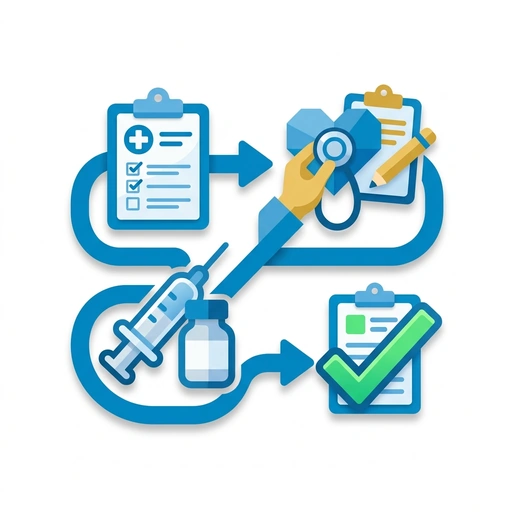
The Nursing Process in Practice
Learn how nurses make critical clinical decisions through a systematic problem-solving framework. Turn raw patient clues into focused nursing diagnoses, actionable care plans, and life-saving evaluations.
Like Duolingo, but for The Nursing Process in Practice. Tomo turns the whole topic into a game you play five minutes a day, until it actually sticks.
A short one: 11 levels across 2 sections, about 22 minutes end to end, roughly 4 days at five minutes a day. It moves through Spotting the Real Problem and Delivering Care and Adapting. It starts from scratch.
Free forever · No credit card · iPhone & Android

Key ideas in The Nursing Process in Practice
- Subjective data consists of feelings and symptoms only the patient can experience and describe
- Objective data consists of measurable, observable signs verified by a nurse using senses or instruments
- Pain scales and symptom descriptions are treated as subjective even though they are recorded as numbers
- A baseline defines a patient's personal starting normal, which may differ from typical population averages
- Subsequent nursing shifts compare new findings against the baseline to catch subtle trends of improvement or decline
- Without an initial benchmark, a nurse cannot tell whether a reading represents acute distress or long-standing stability
- Focused assessments target the specific body system tied to an immediate, emergent symptom
- Comprehensive assessments take time to map broad medical and psychosocial history and are saved for non-emergent moments
- Sudden respiratory changes require rapid, targeted evaluation rather than a full body review
- Visual inspection begins immediately at the door by checking posture, work of breathing, and facial expression
- Skin tone changes (such as pallor or cyanosis) and chest rise indicate respiratory and circulatory effort before monitors are placed
- Blood pressure and internal body temperature require physical instrumentation and cannot be seen across the room
- Medical diagnoses name the underlying pathology or disease process
- Nursing diagnoses capture how a patient functions, adapts, and responds emotionally or physically
- Nurses cannot independently alter a medical diagnosis, but they direct care toward the human response
- A full nursing diagnosis starts with the core problem or unaddressed response
You've tried the other tabs
Thirty open tabs. Four facts you actually kept.
You watched. You nodded. By Sunday it was gone.
One answer, then back to scrolling.
Eight weeks. You meant to finish. You didn't.
Tomo gives The Nursing Process in Practice the Duolingo treatment: levels, streaks, and quick quizzes that test what you just learned. That game loop is what the tabs above never had, so it's the one you actually finish.
Here's what playing it feels like
A real question from this course. Take your best guess.
Which of these patient clues counts as objective data?
Get it right to open this lesson and 10 more in the app.
How to learn The Nursing Process in Practice, step by step
Go in order. 11 short levels across 2 sections, about 22 minutes in all, five minutes a day.
- 1
Spotting the Real Problem
- Gathering Patient Clues
- Framing the Response, Not the Disease
- 2
Delivering Care and Adapting
- Setting Targets and Taking Action
- Evaluating Progress and Pivoting
2 sections · 4 units · 11 levels. Built to play, not to enroll.
Questions about The Nursing Process in Practice
How do I learn The Nursing Process in Practice?
Go in order: start with Spotting the Real Problem, then Delivering Care and Adapting. On Tomo that's 11 short levels, about 22 minutes in all, played five minutes a day. Start free and play the first level in under a minute.
Is there a Duolingo-style app for The Nursing Process in Practice?
Yes. Tomo works like Duolingo: short daily lessons, streaks and quick quizzes. The Nursing Process in Practice is one of its free courses, and you can type any other topic to get a course of your own.
Is The Nursing Process in Practice free?
Yes. The Nursing Process in Practice is playable on Tomo's free plan, which doesn't expire. No credit card, no waitlist. Download the app and start your first lesson.
How long does it take to learn The Nursing Process in Practice?
11 levels across 2 sections, about 22 minutes of play in total. It's built for five minutes a day, so you finish it a little at a time instead of all at once.
Do I need any background to start The Nursing Process in Practice?
No. It's pitched at a beginner level, so it starts where you are and builds up. If you can tap a phone, you can start.
Tomo is in ChatGPT
Tomo is also a ChatGPT plugin: the same playable courses, built and played inside your chat.
Add Tomo to ChatGPT- What to ask
- “Make me a Tomo course on black holes.” “Turn this chat into a Tomo course.”
- What you get
- Quick questions with instant feedback, hearts and stars, ready to play in about a minute.
- Where it goes
- No sign-up to start. Connect your Tomo account and your streak carries on in the app.
You pick the voice
The Nursing Process in Practice is taught in the Bestie style: your friend who just gets it. Want a different feel? In the app you can spin up the same topic in any of Tomo's teaching styles. Same facts, totally different vibe.
More Health on Tomo
Integrated Clinical Assessment
Bridge the gap between raw examination maneuvers and smart diagnostic reasoning. Learn to gather focused histories, target physical exams using likelihood ratios, and build shared care plans.
Occupational Therapy: Skills for Living
Discover how to help people of all ages regain independence and participate in the activities that make life meaningful through the science of 'doing'.
Human Anatomy for Nursing
Learn to read the human body through the eyes of a bedside clinician. Connect structural landmarks, vital organ positions, and anatomical pathways directly to daily patient assessment.
Clinical Nutrition and Dietetics
Step into the clinical mindset of a registered dietitian. Learn how to conduct nutrition assessments, prescribe medical nutrition therapies, manage complex feeding routes, and counsel patients effectively.
Complementary Medicine
Learn how therapies like acupuncture, herbal remedies, and mindfulness work alongside conventional medicine. Gain the tools to evaluate scientific evidence, avoid safety risks, and make smart health decisions.
Thinking Through Patient Cases
Learn how clinicians analyze symptoms, spot hidden emergencies, and make sound decisions. Move from reading confusing patient charts to cracking real clinical scenarios with confidence.
Start The Nursing Process in Practice today.
Download Tomo, search The Nursing Process in Practice, and play your first lesson in under a minute.