
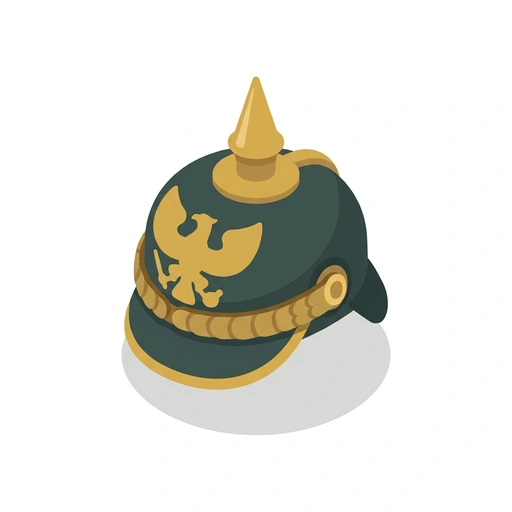
The Pickelhaube: Anatomy and Eclipse
Examine the craftsmanship, military logic, and tactical reality behind Europe's most recognizable spiked helmet. Discover how an aristocratic 19th-century status symbol evolved across imperial armies before shattering against the brutal realities of industrial warfare.
Like Duolingo, but for The Pickelhaube: Anatomy and Eclipse. Tomo turns the whole topic into a game you play five minutes a day, until it actually sticks.
A short one: 7 levels across 2 sections, about 14 minutes end to end, roughly 3 days at five minutes a day. It moves through Decoding the Spiked Helmet and The Industrial Collapse of an Icon. It assumes you already know the basics.
Free forever · No credit card · iPhone & Android

Key ideas in The Pickelhaube: Anatomy and Eclipse
- The tall spike primarily functioned as a decorative mount to anchor horsehair or feather parade plumes
- The Pickelhaube spike had base flutes that rotated or channeled air to ventilate the soldier's head
- The spike offered no structural defensive capability against weapons and was prone to snagging branches
- Standard infantry Pickelhauben were pressed from vegetable-tanned, boiled leather called cuir bouilli
- Boiled leather preserved a glossy, rigid shape for drills but shattered easily under artillery shrapnel
- The severe lack of ballistic protection forced the German army to replace the Pickelhaube with the steel Stahlhelm in 1916
- After 1897, the Reich cockade (black-white-red) was standardized on the wearer's right side
- The constituent state cockade (such as white-and-blue for Bavaria or black-and-white for Prussia) was placed on the wearer's left side
- Both cockades (kokarden) were stamped metal rings pinned beneath the chinstrap mounting bosses
- Every German contingent wore its own sovereign heraldry on the Pickelhaube's front plate (Wappen)
- Prussian helmets bore the crowned eagle, while Bavarian plates featured a distinctive crowned crest with lions
- Cuirassier Pickelhauben abandoned boiled leather for heavy polished steel or copper-zinc tombak alloy
- Heavy cavalry patterns incorporated an articulated, lobster-tail metal neck guard to protect riders against downward saber strikes
- The substantial weight of metal cavalry helmets was accepted solely to defend mounted troops in high-speed melee combat
- Tsar Nicholas I adopted spiked leather helmets for Russian infantry shortly after Prussia in 1844.
- The US Army outfitted cavalry, artillery, and infantry in spiked felt helmets through the late 1800s.
You've tried the other tabs
Thirty open tabs. Four facts you actually kept.
You watched. You nodded. By Sunday it was gone.
One answer, then back to scrolling.
Eight weeks. You meant to finish. You didn't.
Tomo gives The Pickelhaube: Anatomy and Eclipse the Duolingo treatment: levels, streaks, and quick quizzes that test what you just learned. That game loop is what the tabs above never had, so it's the one you actually finish.
Here's what playing it feels like
A real question from this course. Take your best guess.
What practical role did the small fluted openings at the base of the spike serve?
Get it right to open this lesson and 6 more in the app.
Where The Pickelhaube: Anatomy and Eclipse takes you
- 1
Decoding the Spiked Helmet
- Anatomy Beyond the Parade Myth
- Global Adoption and Field Camouflage
- 2
The Industrial Collapse of an Icon
- Trench Reality and the Ersatz Transition
2 sections · 3 units · 7 levels. Built to play, not to enroll.
Tomo is in ChatGPT
Tomo is also a ChatGPT plugin: the same playable courses, built and played inside your chat.
Add Tomo to ChatGPT- What to ask
- “Make me a Tomo course on black holes.” “Turn this chat into a Tomo course.”
- What you get
- Quick questions with instant feedback, hearts and stars, ready to play in about a minute.
- Where it goes
- No sign-up to start. Connect your Tomo account and your streak carries on in the app.
You pick the voice
The Pickelhaube: Anatomy and Eclipse is taught in the Professor style: clear, structured, thorough. Want a different feel? In the app you can spin up the same topic in any of Tomo's teaching styles. Same facts, totally different vibe.
More History on Tomo

The Great War: Beyond the Trenches
Move beyond basic dates to understand the human experience, the shifting maps of empires, and the technological leaps that changed warfare forever. Discover how a single spark ignited a global fire that still shapes our world today.

How Mythology Works
Unpack the recurring blueprints, gods, and monsters across world cultures. Discover why ancient stories share striking patterns and how they shaped the human understanding of reality.
Patterns of World History
Unpack the structural forces that built our modern world. Trace how energy transitions, trade networks, ecological shocks, and institutional shifts steered the human journey from deep prehistory to globalized modernity.

World History: The Big Patterns
Understand how migration, trade, empire, and revolution shaped the modern globe. Connect everyday aspects of your life to the historic turning points that made them.

How Global Politics Works
Learn how power really flows between nations and why countries make the strategic choices they do. Decode foreign news headlines, understand treaties and alliances, and see through the theater of international relations.

Eras That Shaped Human History
Trace how steam engines, ancient debates, trade caravans, and the first planted seeds built the modern world. Discover the defining eras that transformed human life without getting lost in dry dates. Walk away with a clear mental map of our shared journey.
Start The Pickelhaube: Anatomy and Eclipse today.
Download Tomo, search The Pickelhaube: Anatomy and Eclipse, and play your first lesson in under a minute.