
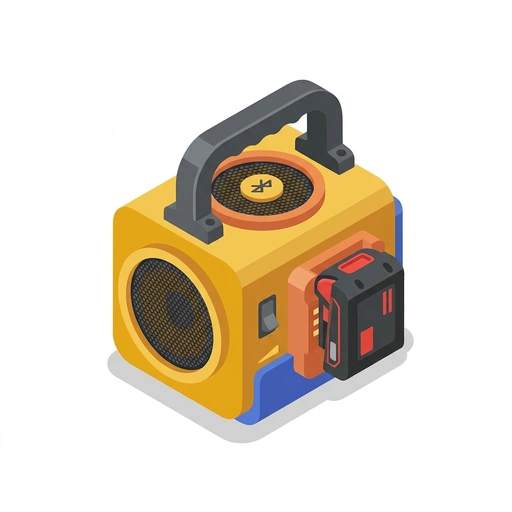
Build Your Own Power Tool Speaker
Like Duolingo, but for Build Your Own Power Tool Speaker. Tomo turns the whole topic into a game you play five minutes a day, until it actually sticks.
For the part of you with thirty open tabs that never became anything.
170 levels across 8 sections, about 340 minutes end to end, roughly 68 days at five minutes a day. It moves through Making Your First Sound, Using Your Power Tool Batteries, Building a Tough Case, Adding Pro Features, Fixing Common Problems, Choosing Better Parts, How the Electricity Works, and Advanced Audio Science. It starts from scratch.
Free forever · No credit card · iPhone & Android
Key ideas in Build Your Own Power Tool Speaker
- The board converts digital wireless data into analog electrical signals
- VCC or '+' indicates the positive voltage rail
- The board acts as the source for the amplifier
- GND or '-' indicates the common ground or negative return
- Identifying power input markings on a PCB
- The role of the Bluetooth board in the audio signal chain
- Reversing polarity usually causes immediate, irreversible chip failure
- The board enters pairing mode automatically upon power-up if not connected
- Small DIY modules rarely have reverse-polarity protection circuits
- Generic modules often appear with alphanumeric or 'BT' prefix names
- Metal shields and blocks Bluetooth radio waves
- L-Out and R-Out provide the left and right audio channels
- The consequence of reversing power polarity
- The antenna side of the board needs a clear path to the outside
- AGND (Audio Ground) is the shared return for the audio signal
- The process of pairing a phone to a new module
You've tried the other tabs
Thirty open tabs. Four facts you actually kept.
You watched. You nodded. By Sunday it was gone.
One answer, then back to scrolling.
Eight weeks. You meant to finish. You didn't.
Tomo gives Build Your Own Power Tool Speaker the Duolingo treatment: levels, streaks, and quick quizzes that test what you just learned. That game loop is what the tabs above never had, so it's the one you actually finish.
Here's what playing it feels like
A real question from this course. Take your best guess.
When you are looking at the power input on your board, what label marks the positive voltage rail?
Get it right to open this lesson and 169 more in the app.
Where Build Your Own Power Tool Speaker takes you
Transform your spare power tool batteries into a high-performance portable sound system. Learn to wire step-down converters and build a rugged speaker that lasts all day on a single charge.
- 1
Making Your First Sound
- Connecting the Bluetooth Board
- Wiring Your First Speaker Driver
- The Quickest Way to Get Power
- Testing for Sound Quality
- 2
Using Your Power Tool Batteries
- Why 20 Volts is Too Much for 12 Volt Gear
- Choosing the Right Battery Adapter
- Installing the Step-Down Converter
- Setting the Output Voltage with a Multimeter
- Safe Ways to Connect and Disconnect
- 3
Building a Tough Case
- Picking the Right Box Material
- Cutting Holes for Speakers and Ports
- Sealing the Box for Better Bass
- 4
Adding Pro Features
- Installing an External Power Switch
- Adding a Battery Level Indicator
- Mounting the Volume Knob
- Adding a USB Port to Charge Your Phone
- Protecting Your Electronics from Vibration
- 5
Fixing Common Problems
- Getting Rid of Hiss and Hum
- What to Do if the Converter Gets Hot
- Troubleshooting Bluetooth Connection Issues
- Dealing with Rattles and Buzzes
- 6
Choosing Better Parts
- Comparing Different Bluetooth Chips
- Full-Range vs. Tweeter and Woofer Sets
- High-Efficiency Converters for Longer Playtime
- Understanding Speaker Ohms and Watts
- Selecting the Best Battery Brand for Audio
- When to Use a Pre-Amp
- 7
How the Electricity Works
- The Secret Inside the Step-Down Converter
- How Amps and Volts Change Your Sound
- Why Batteries Lose Power Over Time
- 8
Advanced Audio Science
- Calculating the Perfect Box Volume
- How Crossovers Direct Sound
- The Physics of Sound Waves in Small Spaces
- Wiring Batteries in Series vs. Parallel
8 sections · 34 units · 170 levels. Built to play, not to enroll.
You pick the voice
Build Your Own Power Tool Speaker is taught in the The Bestie style: your friend who just gets it. Want a different feel? In the app you can spin up the same topic in any of Tomo's teaching styles. Same facts, totally different vibe.
More Technology on Tomo
Mastering the Flow: Practical Electronics
Move beyond simple batteries and bulbs to design circuits that solve real problems. Master the math of power, troubleshoot like a pro, and understand how modern gadgets actually think.
Electronics and Coding with Raspberry Pi
Stop just reading about circuits and start building them. Learn to control the physical world with code, from blinking your first light to designing smart home gadgets.

AI Power User: Level Up Your Workflow
Stop treating AI like a search engine and start using it as a high-level collaborator. Master the art of delegating complex tasks, automating your inbox, and turning hours of research into minutes of insight.

Mastering Maps with QGIS
Stop just looking at maps and start building them. Learn to track weather patterns, analyze local changes, and solve real-world problems using the world's most powerful free mapping tool.
Inside the Machine: Mastering Computer Hardware and Networking
Go beyond basic setup to understand how modern hardware communicates and solves complex problems. Learn to diagnose deep-seated system issues and build robust local networks from the ground up.

Mastering the Magic of Spreadsheets
Stop fighting with rows and columns and start making them work for you. Learn to organize your life, automate your math, and turn messy data into clear answers in minutes.
Start Build Your Own Power Tool Speaker today.
Download Tomo, search Build Your Own Power Tool Speaker, and play your first lesson in under a minute.