
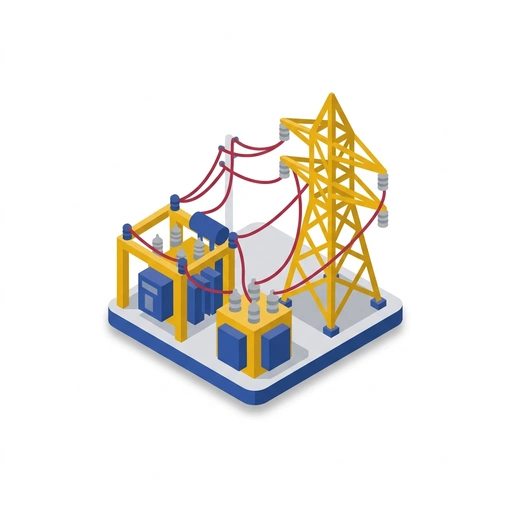
Electrical Power Systems
Analyze complex power distribution networks, diagnose high-frequency transients and harmonics, and design resilient protection schemes. Built for experienced electricians and engineers ready to tackle industrial-scale electrical engineering challenges.
Like Duolingo, but for Electrical Power Systems. Tomo turns the whole topic into a game you play five minutes a day, until it actually sticks.
21 levels across 3 sections, about 42 minutes end to end, roughly 8 days at five minutes a day. It moves through Power Quality and Transient Dynamics, Fault Analysis and Protection Coordination, and Grounding Topologies and Dynamic Industrial Loads.
Free forever · No credit card · iPhone & Android
Key ideas in Electrical Power Systems
- THD calculates harmonic content relative to instantaneous fundamental current, which exaggerates distortion percentages when fundamental current is negligible
- TDD divides root-sum-square harmonic current by the maximum demand load current (IL), reflecting real thermal stress on the utility grid
- IEEE 519 compliance limits are strictly indexed to TDD and short-circuit ratio (Isc/IL) rather than spot THD
- Triplen harmonics (3rd, 9th, 15th) are zero-sequence components that share identical phase displacement (3 × 120° = 360° = 0°)
- Zero-sequence currents add arithmetically rather than cancelling in the neutral conductor, allowing neutral current to reach up to 173% of phase current even under balanced fundamental loading
- Overheating occurs because standard thermal breakers and un-derated neutrals cannot sense or dissipate additive zero-sequence currents
- K-factor quantifies transformer winding eddy current and stray load losses proportional to the square of harmonic order and current amplitude
- High crest-factor loads draw narrow, intense current pulses that generate excessive I²R eddy heating at transformer terminal lugs and core laminations
- Different equipment classes exhibit predictable harmonic spectrums requiring specific K-factor deratings (e.g., standard data centers typically mandate K-13 or K-20)
- Parallel resonance occurs when the inductive reactance of the service transformer equals the capacitive reactance of the PFC bank (hr = √(MVAsc / MVARcap))
- Adding shunt capacitance lowers the resonant frequency of the facility bus into the band of prevalent drive harmonics (typically 5th or 7th)
- At the parallel resonant frequency, bus impedance peaks, magnifying modest harmonic currents into massive harmonic voltages
- Active harmonic filters synthesize and inject instantaneous 180° out-of-phase cancelling currents using IGBT inverters, adapting to changing load profiles in real time
- Passive LC filters present a low impedance to upstream utility harmonics, leading to filter overload from grid harmonic import
- Passive trap filters can cause leading power factor and overvoltage under light-load conditions, whereas AHFs can selectively correct harmonic currents without introducing excessive leading reactive power
- Current chopping forces high di/dt in the primary leakage inductance, generating transient recovery voltages (TRV) that outpace breaker contact gap dielectric recovery
You've tried the other tabs
Thirty open tabs. Four facts you actually kept.
You watched. You nodded. By Sunday it was gone.
One answer, then back to scrolling.
Eight weeks. You meant to finish. You didn't.
Tomo gives Electrical Power Systems the Duolingo treatment: levels, streaks, and quick quizzes that test what you just learned. That game loop is what the tabs above never had, so it's the one you actually finish.
Here's what playing it feels like
A real question from this course. Take your best guess.
Why does Total Demand Distortion (TDD) give a more realistic measure of grid thermal stress than spot THD?
Get it right to open this lesson and 20 more in the app.
How to learn Electrical Power Systems, step by step
Go in order. 21 short levels across 3 sections, about 42 minutes in all, five minutes a day.
- 1
Power Quality and Transient Dynamics
- Harmonic Distortion and Non-Linear Loads
- Transient Surges and High-Frequency Waveforms
- 2
Fault Analysis and Protection Coordination
- Symmetrical Components and Fault Modeling
- Protective Relaying and Selective Coordination
- Arc Flash Quantification and Energy Mitigation
- 3
Grounding Topologies and Dynamic Industrial Loads
- System Grounding and Zero-Sequence Paths
- Motor Dynamics and Voltage Recovery
3 sections · 7 units · 21 levels. Built to play, not to enroll.
Questions about Electrical Power Systems
How do I learn Electrical Power Systems?
Go in order: start with Power Quality and Transient Dynamics, then Fault Analysis and Protection Coordination, then Grounding Topologies and Dynamic Industrial Loads. On Tomo that's 21 short levels, about 42 minutes in all, played five minutes a day. Start free and play the first level in under a minute.
Is there a Duolingo-style app for Electrical Power Systems?
Yes. Tomo works like Duolingo: short daily lessons, streaks and quick quizzes. Electrical Power Systems is one of its free courses, and you can type any other topic to get a course of your own.
Is the Electrical Power Systems course free?
Yes. Electrical Power Systems is playable on Tomo's free plan, which doesn't expire. No credit card, no waitlist. Download the app and start your first lesson.
How long does it take to learn Electrical Power Systems?
21 levels across 3 sections, about 42 minutes of play in total. It's built for five minutes a day, so you finish it a little at a time instead of all at once.
Do I need any background to start Electrical Power Systems?
No. It's pitched at an advanced level, so it starts where you are and builds up. If you can tap a phone, you can start.
Tomo is in ChatGPT
Tomo is also a ChatGPT plugin: the same playable courses, built and played inside your chat.
Add Tomo to ChatGPT- What to ask
- “Make me a Tomo course on black holes.” “Turn this chat into a Tomo course.”
- What you get
- Quick questions with instant feedback, hearts and stars, ready to play in about a minute.
- Where it goes
- No sign-up to start. Connect your Tomo account and your streak carries on in the app.
You pick the voice
Electrical Power Systems is taught in the Professor style: clear, structured, thorough. Want a different feel? In the app you can spin up the same topic in any of Tomo's teaching styles. Same facts, totally different vibe.
More Technology on Tomo
Commercial Electrical Systems & Math
Bridge the gap between roughing-in conduit and passing commercial certification. Master three-phase power, precision voltage calculations, transformer connections, and motor circuit sizing.
Electricity and Practical Circuits
Move beyond basic textbook formulas to build a working intuition for real circuits. Learn how components behave under load, diagnose tricky faults, and master the forces shaping electrical systems.
Designing Electronic Systems
Bridge the gap between simple breadboard circuits and robust, functional hardware systems. Learn how to condition analog signals, manage power and switching loads, coordinate noisy digital communication, and track down real-world hardware bugs.
High-Performance LS Engine Blueprinting
Master the precision blueprinting tolerances, valvetrain harmonics, and oiling system modifications required to keep high-output GM LS engines alive under severe RPM and boost.
Ohm's Law in Circuit Design
Bridge the gap between textbook formulas and reliable hardware. Learn how professional engineers apply Ohm's law to size real loads, account for parasitic resistance, troubleshoot ground drops, and manage thermal limits.
High-Performance Car Mechanics
Examine the advanced engineering that governs vehicle dynamics, forced induction, and powertrain control. Learn how acoustic resonance, transient boost, differential ramps, and thermal limits dictate real-world mechanical performance.
Start Electrical Power Systems today.
Download Tomo, search Electrical Power Systems, and play your first lesson in under a minute.