
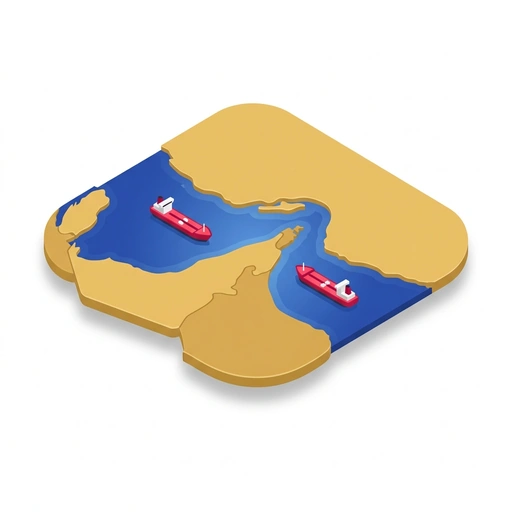
The Strait of Hormuz
Understand why a narrow 21-mile waterway holds the key to global energy flows and maritime strategy. Trace the geography between Iran and Oman, explore the incentives of Gulf states and world powers, and decode how deterrence works in a vital global choke point.
Like Duolingo, but for The Strait of Hormuz. Tomo turns the whole topic into a game you play five minutes a day, until it actually sticks.
A short one: 12 levels across 2 sections, about 24 minutes end to end, roughly 5 days at five minutes a day. It moves through The Choke Point in Motion and The Chessboard on the Water. It starts from scratch.
Free forever · No credit card · iPhone & Android

Key ideas in The Strait of Hormuz
- The Strait of Hormuz is framed by Iran's southern coast on the north and Oman's Musandam Peninsula on the south
- The channel narrows to only about 21 nautical miles wide at its tightest choke point
- The Musandam Peninsula is an exclave of Oman separated from the rest of the country by the UAE
- Tankers cannot freely roam the waterway and must follow a formal Traffic Separation Scheme (TSS)
- The scheme consists of an inbound lane and an outbound lane, each two miles wide, separated by a two-mile buffer zone
- This system enforces strict one-way movement to avoid collisions in close quarters
- Both the inbound and outbound commercial shipping lanes lie entirely within Omani territorial waters
- Deep water necessary for draft-heavy supertankers runs closest to the Musandam Peninsula
- Oman acts as the quiet, crucial maritime custodian of the strait despite maintaining a much smaller navy than Iran
- Shallows and coral reefs along the Arabian coast make detouring outside designated channels perilous for deep-draft ships
- Islands like Abu Musa and the Greater and Lesser Tunbs sit directly near the shipping paths and are contested by Iran and the UAE
- Geographic hazards make it nearly impossible for merchant ships to simply steer around trouble if the main lanes are threatened
- The Persian Gulf is a semi-enclosed sea with no other natural maritime exit to the world's oceans
- States located inside the Gulf—including Kuwait, Qatar, Bahrain, and upper Gulf ports of Iraq and Saudi Arabia—must transit Hormuz twice per voyage (in and out)
- Oman and Yemen have open coastlines along the Gulf of Oman, Arabian Sea, or Red Sea, so their ports do not require passing through Hormuz
- Around 20% of the world's daily petroleum supply passes through the Strait of Hormuz
You've tried the other tabs
Thirty open tabs. Four facts you actually kept.
You watched. You nodded. By Sunday it was gone.
One answer, then back to scrolling.
Eight weeks. You meant to finish. You didn't.
Tomo gives The Strait of Hormuz the Duolingo treatment: levels, streaks, and quick quizzes that test what you just learned. That game loop is what the tabs above never had, so it's the one you actually finish.
Here's what playing it feels like
A real question from this course. Take your best guess.
If you look at a map of the Strait of Hormuz, which two shores pinch this famous waterway?
Get it right to open this lesson and 11 more in the app.
How to learn The Strait of Hormuz, step by step
Go in order. 12 short levels across 2 sections, about 24 minutes in all, five minutes a day.
- 1
The Choke Point in Motion
- Navigating the Narrow Neck
- The World's Energy Artery
- 2
The Chessboard on the Water
- Coastlines, Islands, and Conflicting Interests
- Shadow Wars, Deterrence, and Global Stakes
2 sections · 4 units · 12 levels. Built to play, not to enroll.
Questions about The Strait of Hormuz
How do I learn The Strait of Hormuz?
Go in order: start with The Choke Point in Motion, then The Chessboard on the Water. On Tomo that's 12 short levels, about 24 minutes in all, played five minutes a day. Start free and play the first level in under a minute.
Is there a Duolingo-style app for The Strait of Hormuz?
Yes. Tomo works like Duolingo: short daily lessons, streaks and quick quizzes. The Strait of Hormuz is one of its free courses, and you can type any other topic to get a course of your own.
Is The Strait of Hormuz free?
Yes. The Strait of Hormuz is playable on Tomo's free plan, which doesn't expire. No credit card, no waitlist. Download the app and start your first lesson.
How long does it take to learn The Strait of Hormuz?
12 levels across 2 sections, about 24 minutes of play in total. It's built for five minutes a day, so you finish it a little at a time instead of all at once.
Do I need any background to start The Strait of Hormuz?
No. It's pitched at a beginner level, so it starts where you are and builds up. If you can tap a phone, you can start.
Tomo is in ChatGPT
Tomo is also a ChatGPT plugin: the same playable courses, built and played inside your chat.
Add Tomo to ChatGPT- What to ask
- “Make me a Tomo course on black holes.” “Turn this chat into a Tomo course.”
- What you get
- Quick questions with instant feedback, hearts and stars, ready to play in about a minute.
- Where it goes
- No sign-up to start. Connect your Tomo account and your streak carries on in the app.
You pick the voice
The Strait of Hormuz is taught in the Bestie style: your friend who just gets it. Want a different feel? In the app you can spin up the same topic in any of Tomo's teaching styles. Same facts, totally different vibe.
More History on Tomo
Geopolitics: The World's Hidden Rules
Understand why nations behave the way they do by looking at the map. Learn to see the world as a high-stakes game of chess where geography dictates the moves.
How Global Politics Works
Learn how power really flows between nations and why countries make the strategic choices they do. Decode foreign news headlines, understand treaties and alliances, and see through the theater of international relations.
India: The Fabric of Power
Move beyond dates and dynasties to see how trade, faith, and rebellion stitched together the world's largest democracy. Explore the hidden threads that connect ancient silk routes to the modern global stage.
International Relations in the Real World
Decode the daily headlines and understand why countries cooperate, compete, and clash. Explore how power, trade, alliances, and security dilemmas shape today's global landscape.

The Life and Ideas of Jesus
Explore the historical context, radical teachings, and lasting impact of the man from Nazareth who reshaped the world.
Eras That Shaped Human History
Trace how steam engines, ancient debates, trade caravans, and the first planted seeds built the modern world. Discover the defining eras that transformed human life without getting lost in dry dates. Walk away with a clear mental map of our shared journey.
Start The Strait of Hormuz today.
Download Tomo, search The Strait of Hormuz, and play your first lesson in under a minute.