
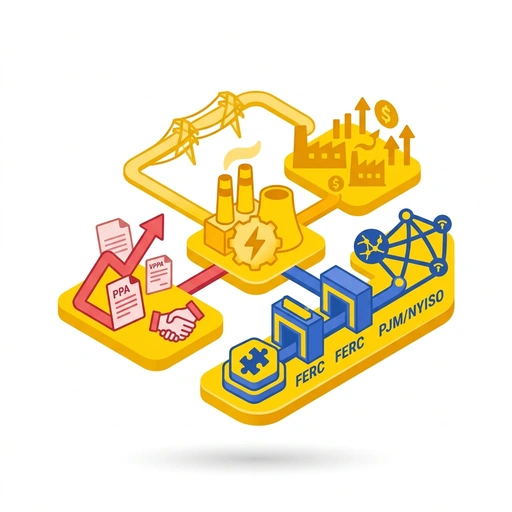
Grid Markets and Interconnection
Master the mechanics of power markets, from the physics of locational pricing to the legal complexities of FERC Order 2023 and the interconnection queue.
Like Duolingo, but for Grid Markets and Interconnection. Tomo turns the whole topic into a game you play five minutes a day, until it actually sticks.
86 levels across 8 sections, about 172 minutes end to end, roughly 34 days at five minutes a day. It moves through The Price of an Electron, Reliability and Capacity Markets, Getting on the Grid, Federal Oversight and the Law, Large Loads and the Jurisdictional Seam, Power Purchase Agreements (PPAs), Advanced Decarbonization Strategies, and Synthesis and Critical Review. It starts from scratch.
Free forever · No credit card · iPhone & Android
Key ideas in Grid Markets and Interconnection
- The most expensive generator needed to meet demand is the 'marginal unit'
- All generators at a node receive the clearing price set by that marginal unit
- Lower-cost generators do not receive their bid price, but the higher market clearing price
- LMP is not a single number but a calculation of three distinct factors
- Congestion only appears when a transmission constraint is active
- Losses account for the physical reality that not all power sent reaches the destination
- The marginal unit sets the price for all
- LMP Components
- Nodal pricing creates different prices at different points (buses) on the grid
- Prices vary based on local supply, local demand, and the ability of the wires to get power there
- The marginal unit of generation sets the price for the entire node
- Constraints prevent cheap power from reaching high-demand areas
- Price separation means the 'downstream' side of a bottleneck sees much higher prices
- LMP is the sum of energy, congestion, and loss components
- The 'upstream' side sees lower prices because cheap power is trapped there
- Shadow prices measure the 'pain' or cost of a specific constraint
You've tried the other tabs
Thirty open tabs. Four facts you actually kept.
You watched. You nodded. By Sunday it was gone.
One answer, then back to scrolling.
Eight weeks. You meant to finish. You didn't.
Tomo gives Grid Markets and Interconnection the Duolingo treatment: levels, streaks, and quick quizzes that test what you just learned. That game loop is what the tabs above never had, so it's the one you actually finish.
Here's what playing it feels like
A real question from this course. Take your best guess.
Picture three different power plants at the same hub. If the marginal unit sets a price, what do the other plants receive?
Get it right to open this lesson and 85 more in the app.
How to learn Grid Markets and Interconnection, step by step
Go in order. 86 short levels across 8 sections, about 2 hours 52 minutes in all, five minutes a day.
- 1
The Price of an Electron
- Locational Marginal Pricing (LMP) Basics
- Congestion and Line Losses
- The Energy Market Stack
- 2
Reliability and Capacity Markets
- The Missing Money Problem
- The ERCOT Energy-Only Model
- 3
Getting on the Grid
- The Interconnection Queue Lifecycle
- Serial vs. Cluster Studies
- FERC Order 2023 Reforms
- Queue Attrition and Withdrawal Realities
- 4
Federal Oversight and the Law
- FERC Jurisdiction and Section 206
- The June 2026 Show Cause Orders
- Rulemaking vs. Adjudication
- 5
Large Loads and the Jurisdictional Seam
- The Load Interconnection Gap
- Non-Firm Service for Large Loads
- Economic Development Rates (EDR)
- 6
Power Purchase Agreements (PPAs)
- Physical PPAs and Sleeved Deliveries
- Virtual PPAs (VPPA) and Basis Risk
- Renewable Energy Credits (RECs) and Attributes
- 7
Advanced Decarbonization Strategies
- Annual vs. Hourly Matching
- The Last 30% Challenge
- 8
Synthesis and Critical Review
- Building a Market Analysis Artifact
- Attacking the Methodology
8 sections · 22 units · 86 levels. Built to play, not to enroll.
Questions about Grid Markets and Interconnection
How do I learn Grid Markets and Interconnection?
Go in order: start with The Price of an Electron, then Reliability and Capacity Markets, then Getting on the Grid, then Federal Oversight and the Law, and 4 more sections after that. On Tomo that's 86 short levels, about 2 hours 52 minutes in all, played five minutes a day. Start free and play the first level in under a minute.
Is there a Duolingo-style app for Grid Markets and Interconnection?
Yes. Tomo works like Duolingo: short daily lessons, streaks and quick quizzes. Grid Markets and Interconnection is one of its free courses, and you can type any other topic to get a course of your own.
Is the Grid Markets and Interconnection course free?
Yes. Grid Markets and Interconnection is playable on Tomo's free plan, which doesn't expire. No credit card, no waitlist. Download the app and start your first lesson.
How long does it take to learn Grid Markets and Interconnection?
86 levels across 8 sections, about 2 hours 52 minutes of play in total. It's built for five minutes a day, so you finish it a little at a time instead of all at once.
Do I need any background to start Grid Markets and Interconnection?
No. It's pitched at a beginner level, so it starts where you are and builds up. If you can tap a phone, you can start.
Tomo is in ChatGPT
Tomo is also a ChatGPT plugin: the same playable courses, built and played inside your chat.
Add Tomo to ChatGPT- What to ask
- “Make me a Tomo course on black holes.” “Turn this chat into a Tomo course.”
- What you get
- Quick questions with instant feedback, hearts and stars, ready to play in about a minute.
- Where it goes
- No sign-up to start. Connect your Tomo account and your streak carries on in the app.
You pick the voice
Grid Markets and Interconnection is taught in the Storyteller style: every lesson is a story. Want a different feel? In the app you can spin up the same topic in any of Tomo's teaching styles. Same facts, totally different vibe.
More Technology on Tomo
Business Automation with n8n
Move beyond simple triggers to build complex, AI-powered business systems. Learn to orchestrate data, integrate LLMs like Claude, and solve real-world consulting challenges with node-based logic.
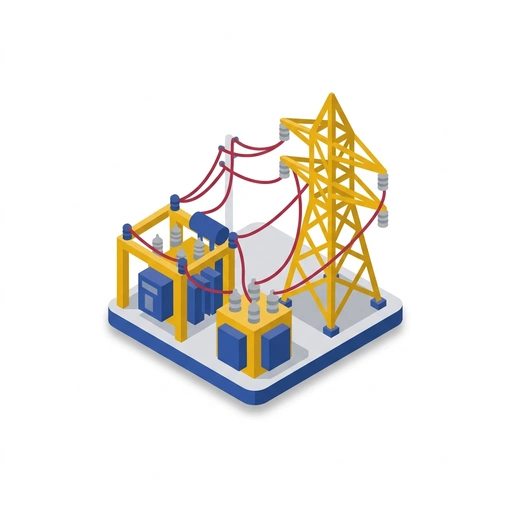
Electrical Power Systems
Analyze complex power distribution networks, diagnose high-frequency transients and harmonics, and design resilient protection schemes. Built for experienced electricians and engineers ready to tackle industrial-scale electrical engineering challenges.
Raspberry Pi and ESP Hardware
Learn how microcontrollers and single-board computers bring physical projects to life. Discover how to choose the right board, wire sensors, write firmware, and build reliable smart devices.
AI-Native Software Engineering
Transition from using AI as a chatbot to integrating it as a core architectural component. This course covers advanced agentic workflows, automated evaluation loops, and the shift toward non-deterministic system design.
Practical Circuit Design
Move beyond basic breadboard recipes to design reliable, real-world circuits. Learn to drive high-power loads, shape signals with op-amps, clean up noisy power rails, and debug circuits with confidence.

Mastering Arch Linux and Python Workflows
Level up your Arch Linux skills by optimizing CachyOS for performance and building a seamless bridge between your system and Python development environments.
Start Grid Markets and Interconnection today.
Download Tomo, search Grid Markets and Interconnection, and play your first lesson in under a minute.