
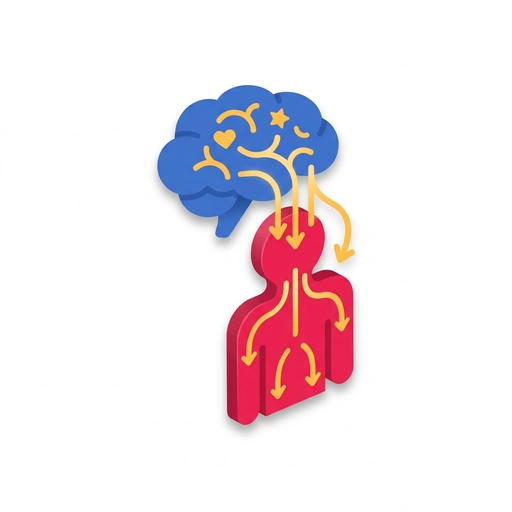
How Emotions Shape the Body
Trace the exact biological pathways connecting emotional states to physical symptoms. Learn how autonomic signals, hormones, and immune responses alter your tissues, and practice concrete tools to regulate somatic feedback loops.
Like Duolingo, but for How Emotions Shape the Body. Tomo turns the whole topic into a game you play five minutes a day, until it actually sticks.
24 levels across 3 sections, about 48 minutes end to end, roughly 10 days at five minutes a day. It moves through Reading and Resetting Autonomic States; The Biological Cascade: Hormones, Gut, and Immunity; and Neurobiology, Pain, and Somatic Rewiring. It assumes you already know the basics.
Free forever · No credit card · iPhone & Android
Key ideas in How Emotions Shape the Body
- Sensory signals reach the amygdala via the low road before reaching the cortex
- The amygdala initiates peripheral autonomic changes within milliseconds
- Conscious recognition of fear occurs only after bodily arousal has begun
- Chronic jaw clenching reflects suppressed emotional expression and hostility
- Mid-body bracing freezes the diaphragm to maintain silent vigilance
- The pelvic floor chronically contracts during sustained defensive anticipation
- A second sharp inhale reinflates collapsed pulmonary alveoli
- Prolonged exhales expand thoracic space, cueing vagal deceleration of heart rate
- The autonomic sigh resets sympathetic arousal faster than rhythmic equal breathing
- Describing raw bodily sensation shifts activity from amygdala to prefrontal cortex
- Labeling sensations as narrative threat amplifies autonomic panic loops
- High-density cutaneous mechanoreceptors flood the insula with tangible sensory data
- External tactile input competes with and interrupts internal threat alarm signals
- Cognitive rumination maintains sympathetic arousal instead of grounding the nervous system
- Ventral vagal activation enables social connection and vocal prosody.
- Sympathetic mobilization drives heart acceleration and defensive action.
You've tried the other tabs
Thirty open tabs. Four facts you actually kept.
You watched. You nodded. By Sunday it was gone.
One answer, then back to scrolling.
Eight weeks. You meant to finish. You didn't.
Tomo gives How Emotions Shape the Body the Duolingo treatment: levels, streaks, and quick quizzes that test what you just learned. That game loop is what the tabs above never had, so it's the one you actually finish.
Here's what playing it feels like
A real question from this course. Take your best guess.
How quickly does your amygdala trigger bodily changes like a racing heartbeat?
Get it right to open this lesson and 23 more in the app.
Where How Emotions Shape the Body takes you
- 1
Reading and Resetting Autonomic States
- Decoding Immediate Somatic Alarms
- Working with the Autonomic Nervous System
- 2
The Biological Cascade: Hormones, Gut, and Immunity
- The Endocrine Trail and the HPA Axis
- The Gut-Brain Axis and Emotional Digestion
- Psychoneuroimmunology and the Inflammatory Loop
- 3
Neurobiology, Pain, and Somatic Rewiring
- Interoception and the Predictive Brain
- Pain Neurobiology and Central Sensitization
- Retraining the Neurovisceral Architecture
3 sections · 8 units · 24 levels. Built to play, not to enroll.
Tomo is in ChatGPT
Tomo is also a ChatGPT plugin: the same playable courses, built and played inside your chat.
Add Tomo to ChatGPT- What to ask
- “Make me a Tomo course on black holes.” “Turn this chat into a Tomo course.”
- What you get
- Quick questions with instant feedback, hearts and stars, ready to play in about a minute.
- Where it goes
- No sign-up to start. Connect your Tomo account and your streak carries on in the app.
You pick the voice
How Emotions Shape the Body is taught in the Explain Like I'm 5 style: no big words. promise.. Want a different feel? In the app you can spin up the same topic in any of Tomo's teaching styles. Same facts, totally different vibe.
More Psychology on Tomo
The Body's Emotional Language
Discover how your muscles store stress and learn to listen to the physical signals your body sends during emotional moments.
Psychology for Everyday Life
Discover how your mind actually works and apply proven psychological principles to build better habits, read social dynamics, and make sharper decisions.

Taming Sudden Emotions
Learn to halt sudden emotional spikes, broaden your patience during daily friction, and build lasting emotional resilience.
Your Brain, Anxiety, and Neurodiversity
Understand why your brain sounds false alarms, how evolution hardwired anxiety for survival, and what science really tells us about autistic and neurodivergent wiring.

Why We Do What We Do
Unlock the hidden patterns behind human actions, from the habits that shape your day to the social forces that influence your biggest decisions.
Psychology: Mind, Brain, and Behavior
Examine the scientific models that explain human thought, personality, and psychopathology. Connect behavioral patterns and clinical disorders directly to their neural, limbic, and cognitive engines.
Start How Emotions Shape the Body today.
Download Tomo, search How Emotions Shape the Body, and play your first lesson in under a minute.