
Your Brain, Anxiety, and Neurodiversity
Understand why your brain sounds false alarms, how evolution hardwired anxiety for survival, and what science really tells us about autistic and neurodivergent wiring.
Like Duolingo, but for Your Brain, Anxiety, and Neurodiversity. Tomo turns the whole topic into a game you play five minutes a day, until it actually sticks.
A short one: 12 levels across 2 sections, about 24 minutes end to end, roughly 5 days at five minutes a day. It moves through Untangling the Brain's Alarm System and How Different Brains Get Built. It starts from scratch.
Free forever · No credit card · iPhone & Android

Key ideas in Your Brain, Anxiety, and Neurodiversity
- The amygdala acts as an automatic alarm that triggers physical panic instantly
- Physical symptoms happen fractions of a second before conscious awareness
- The conscious prefrontal cortex is the last area to receive and evaluate the situation
- Panic sensations are designed to prepare the body to sprint or fight, not a medical emergency
- Blood moves away from the stomach and brain toward the legs and arms
- A racing pulse and dizzy feeling are standard survival adaptations under fight-or-flight
- The thinking brain shuts down or gets overridden while the body is in full alarm mode
- The prefrontal cortex cannot convince the brain you are safe until bodily sensations calm down first
- Physical safety signals must travel from the body up to the brain before logic works
- Inhaling temporarily speeds the heart up, while long exhales stimulate the vagus nerve to brake it
- The vagus nerve is the physical communication highway that commands the heart and lungs to settle
- Extended exhalation is an active physical brake on fight-or-flight
- Naming the exact feeling ('I am feeling terror and dread') activates the thinking cortex
- Recruiting language centers mechanically reduces the amygdala's electrical activity
- Vague resistance or suppression keeps the alarm firing, whereas precise labeling dials it down
- A false alarm only wastes energy, but failing to detect a real predator leads to death
You've tried the other tabs
Thirty open tabs. Four facts you actually kept.
You watched. You nodded. By Sunday it was gone.
One answer, then back to scrolling.
Eight weeks. You meant to finish. You didn't.
Tomo gives Your Brain, Anxiety, and Neurodiversity the Duolingo treatment: levels, streaks, and quick quizzes that test what you just learned. That game loop is what the tabs above never had, so it's the one you actually finish.
Here's what playing it feels like
A real question from this course. Take your best guess.
When something suddenly scares you, what reacts first?
Get it right to open this lesson and 11 more in the app.
How to learn Your Brain, Anxiety, and Neurodiversity, step by step
Go in order. 12 short levels across 2 sections, about 24 minutes in all, five minutes a day.
- 1
Untangling the Brain's Alarm System
- Calming the Brain's False Alarms
- Why Evolution Wired Us to Worry
- 2
How Different Brains Get Built
- Autism and the Architecture of the Spectrum
- What Shapes a Developing Mind
2 sections · 4 units · 12 levels. Built to play, not to enroll.
Questions about Your Brain, Anxiety, and Neurodiversity
How do I learn Your Brain, Anxiety, and Neurodiversity?
Go in order: start with Untangling the Brain's Alarm System, then How Different Brains Get Built. On Tomo that's 12 short levels, about 24 minutes in all, played five minutes a day. Start free and play the first level in under a minute.
Is there a Duolingo-style app for Your Brain, Anxiety, and Neurodiversity?
Yes. Tomo works like Duolingo: short daily lessons, streaks and quick quizzes. Your Brain, Anxiety, and Neurodiversity is one of its free courses, and you can type any other topic to get a course of your own.
Is the Your Brain, Anxiety, and Neurodiversity course free?
Yes. Your Brain, Anxiety, and Neurodiversity is playable on Tomo's free plan, which doesn't expire. No credit card, no waitlist. Download the app and start your first lesson.
How long does it take to learn Your Brain, Anxiety, and Neurodiversity?
12 levels across 2 sections, about 24 minutes of play in total. It's built for five minutes a day, so you finish it a little at a time instead of all at once.
Do I need any background to start Your Brain, Anxiety, and Neurodiversity?
No. It's pitched at a beginner level, so it starts where you are and builds up. If you can tap a phone, you can start.
Tomo is in ChatGPT
Tomo is also a ChatGPT plugin: the same playable courses, built and played inside your chat.
Add Tomo to ChatGPT- What to ask
- “Make me a Tomo course on black holes.” “Turn this chat into a Tomo course.”
- What you get
- Quick questions with instant feedback, hearts and stars, ready to play in about a minute.
- Where it goes
- No sign-up to start. Connect your Tomo account and your streak carries on in the app.
You pick the voice
Your Brain, Anxiety, and Neurodiversity is taught in the Explain Like I'm 5 style: no big words. promise.. Want a different feel? In the app you can spin up the same topic in any of Tomo's teaching styles. Same facts, totally different vibe.
More Psychology on Tomo
The Architecture of the Mind
Move beyond basic definitions to understand the hidden mechanisms of human behavior, from how we construct reality to why we make irrational social choices.
Psychology: Mind, Brain, and Behavior
Examine the scientific models that explain human thought, personality, and psychopathology. Connect behavioral patterns and clinical disorders directly to their neural, limbic, and cognitive engines.
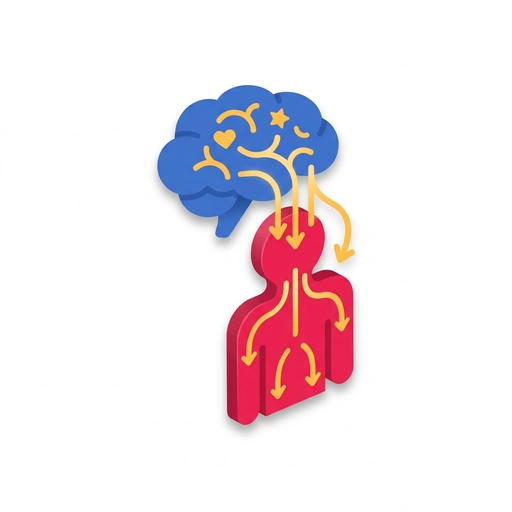
How Emotions Shape the Body
Trace the exact biological pathways connecting emotional states to physical symptoms. Learn how autonomic signals, hormones, and immune responses alter your tissues, and practice concrete tools to regulate somatic feedback loops.
Psychology: How the Mind Works
Explore why people think, feel, and act the way they do. From brain wiring and childhood development to major psychological theories and mental health, discover the working science of human behavior.
Psychology for Everyday Life
Unpack the invisible mental forces that shape your choices, routines, and interactions. Spot common cognitive blind spots and understand why people act the way they do.
Psychology of Daily Behavior
Discover the invisible mental shortcuts and social forces that quietly steer your everyday choices and reactions. Learn to spot cognitive biases in real time, see through subtle persuasion, and read interpersonal situations with clarity.
Start Your Brain, Anxiety, and Neurodiversity today.
Download Tomo, search Your Brain, Anxiety, and Neurodiversity, and play your first lesson in under a minute.